
The way properties are marketed in New Zealand is changing fast. With 97% of buyers starting their search online, high-quality visuals are now critical for real estate success. Virtual property design is stepping up to meet these demands, helping sellers attract buyers and close deals quicker. Here’s what’s driving this trend:
- Virtual staging boosts buyer engagement: Properties with virtual tours see 72.3% more inspections and sell 6.41% faster.
- Cost-effective and fast: Virtual staging costs as little as $10.50–$49 per image, compared to thousands for physical staging, and delivers results in 24 hours or less.
- Tailored designs for buyers: Buyers want personalisation, from custom furniture styles to eco-friendly features that reflect their lifestyle.
- Popular styles: Scandinavian, natural materials, and luxury finishes are leading the way in virtual staging.
Virtual property design is reshaping New Zealand’s real estate market by addressing key challenges like pricing concerns and the lack of suitable options for buyers. Tools like Fast Virtual Staging are making it easier for agents to create visually appealing listings that connect with buyers while staying affordable.
What Consumers Want in Virtual Property Design
Custom Furniture Styles and Layouts
With the shift toward digital property presentations, buyers now expect designs that feel personal and tailored to their tastes. Virtual staging has made this possible, allowing agents to swap out furniture, change colour schemes, and reimagine spaces to suit different preferences and lifestyles. This level of personalisation is especially important in New Zealand, where 95% of people aspire to own their own home. They want to envision themselves living in a space before committing to it.
A notable example is the collaboration between G.J. Gardner Homes New Zealand and Enviz, which introduced a white-label app that lets customers explore home designs at a 1:1 scale. Managing Director Ellie Porteous highlighted the benefits:
"Customers can get a feel for the space, which they can’t get from simply looking at a 2D drawing – this allows them to better understand the layout and flow of the design".
Consumer preferences also vary widely by age. Younger buyers, aged 18-34, are particularly drawn to city apartments and lifestyle blocks, while those over 35 often seek out beach house designs.
Lifestyle-Focused and Multi-Purpose Spaces
The way New Zealanders use their homes is evolving. For instance, 70% of Gen Z value formal living and dining rooms, compared to 43% of Baby Boomers. Campbell Dunoon, Head of Network NZ at LJ Hooker, explains:
"For Gen Z, they [formal spaces] offer a sense of tradition and purpose. They see value in having designated areas for gathering, entertaining, or even just switching off".
Multi-generational living has also become more common, with 60% of New Zealanders preferring homes that include self-contained spaces. Privacy is another priority – 58% of parents would avoid buying a home where children have to share bedrooms. Virtual staging is a powerful tool for showcasing these lifestyle-oriented layouts, helping buyers picture how a home can provide privacy while accommodating multiple needs. These shifting demands also align with a growing interest in environmentally conscious design.
Eco-Friendly Design Elements
Sustainability has become a major focus for modern buyers, reflecting New Zealand’s deep connection to kaitiakitanga – the guardianship of nature. Nearly half of New Zealanders (47%) consider sustainability when choosing brands or products, and this mindset extends to property design. Green Star NZ registrations soared from 21 in 2021 to 88 in 2022, underscoring the increasing demand for certified eco-friendly buildings.
Younger buyers are leading this charge, with 72% of Gen Z and Millennials saying they "always choose the most environmentally friendly option", compared to 55% of those aged 60 and older. Virtual staging itself supports sustainability by being 97% cheaper than physical staging and eliminating waste from furniture production and transport. However, authenticity is key – 75% of New Zealanders want environmental claims to be independently verified. Virtual designs should highlight real eco-friendly features, such as recycled materials, natural textures, and energy-efficient systems, rather than relying on superficial touches like added greenery.
sbb-itb-7b8b2a2
Popular Design Styles in Virtual Staging
Scandinavian and Minimalist Designs
Clean lines and functional designs have long been favourites among New Zealand buyers, especially younger generations. With 48% of Gen Z buyers open to apartment living, minimalist and space-efficient layouts are a natural fit for these compact homes. These styles also work well for showcasing multi-purpose rooms that can shift between home offices and guest spaces.
However, today’s buyers are looking for more than just simplicity – they want spaces with warmth and character. While keeping minimalist principles intact for smaller homes, virtual staging should introduce personality through textured fabrics and carefully selected statement pieces. The goal is to avoid sterile, impersonal spaces and instead create inviting, functional layouts that feel lived-in and unique.
Natural Materials and Earthy Colours
Minimalist clarity is giving way to designs that embrace a more grounded and natural aesthetic. New Zealand’s connection to the environment is reflected in the growing popularity of earthy tones and organic materials. Pantone’s 2025 Colour of the Year, Mocha Mousse, captures this shift perfectly. Laurie Pressman, Vice President of the Pantone Color Institute, describes it as:
"a level of thoughtful indulgence… unpretentious classic… [it] extends our perceptions of the browns from being humble and grounded to embrace aspirational and luxe".
Victoria Bibby highlights how blue and green tones pair beautifully with timber finishes, creating a palette that mirrors New Zealand’s natural landscapes. Virtual staging can bring this to life with timber accents, stone textures, and earthy hues like terracotta, sage green, and sandy beige. Hayley Brown from Lou Brown Design stresses the importance of layering:
"Add texture, texture, texture".
Incorporating elements like linen bedding, woven rugs, natural leather, and sheepskin throws helps create depth and a sense of authenticity, steering clear of flat, generic designs.
Modern and Luxury Finishes
When it comes to premium properties, the focus shifts to high-end finishes and features. Virtual staging for luxury homes often highlights "spa-like" bathrooms with freestanding tubs, rainfall showers, and heated floors. Kitchens, a critical focal point for buyers, are another area where luxury shines. Bold stone choices like Calacatta Viola or Verde Alpi for islands and splashbacks are in demand, with kitchen renovations in New Zealand commanding a median spend of NZ$30,000.
Smart home technology is now a standard expectation for modern luxury. Virtual staging should showcase features like app-controlled locks, automated thermostats, and voice-activated lighting. The "Nancy Meyers-inspired kitchen" trend, with Shaker-style cabinetry, stone countertops, and a balance of luxury and comfort, is another popular choice. For a contemporary edge, sculptural lighting fixtures and furniture with curved, organic shapes cater to the 84% of Gen Z buyers who seek fresh, exciting living spaces. These thoughtful design elements elevate virtual staging, making it a powerful tool for presenting premium properties.
Why Virtual Staging Sells Homes Faster (and for More Money!) | Benefits for Home Sellers
How Virtual Property Design Affects Real Estate Sales
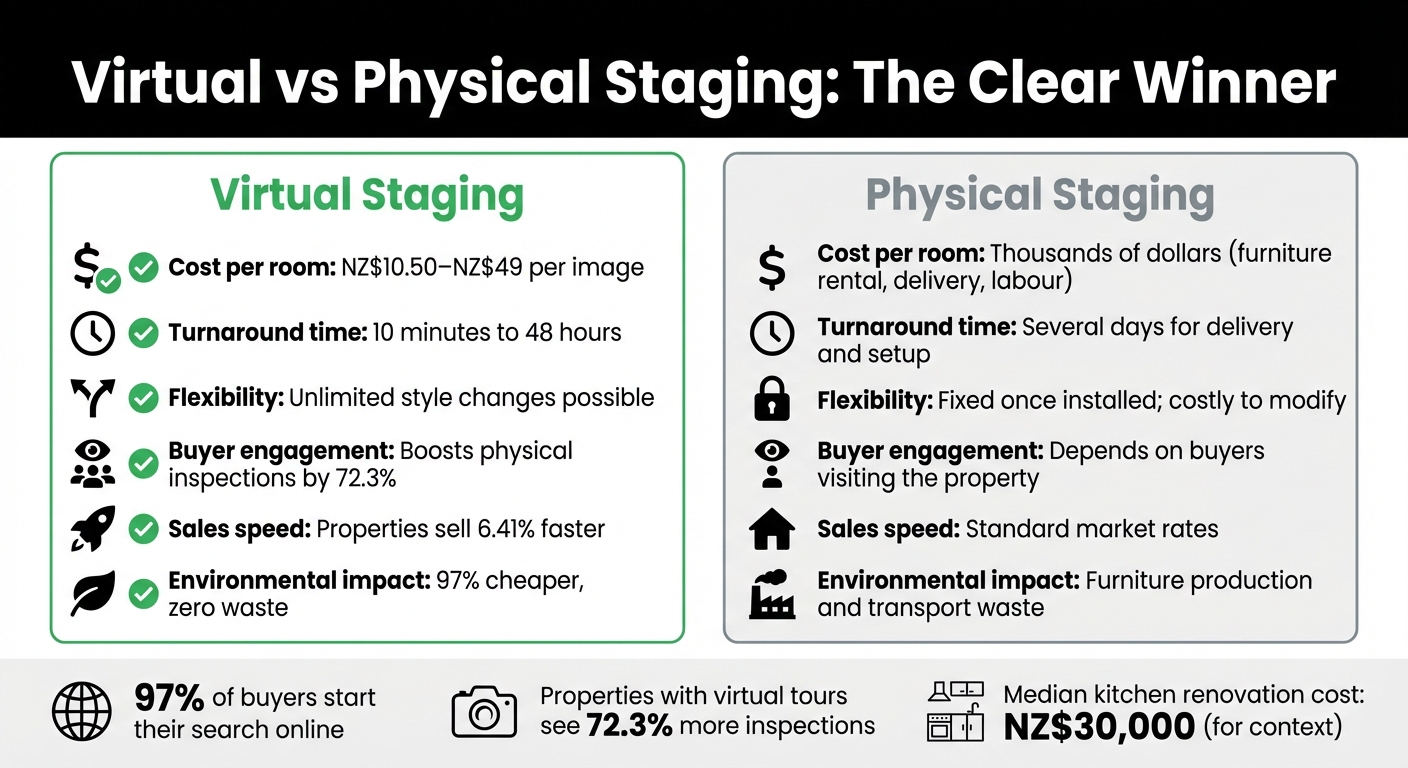
Virtual vs Physical Property Staging: Cost and Performance Comparison
Meeting the growing demand for realistic and budget-friendly solutions, virtual property design is reshaping how real estate is marketed and sold in New Zealand.
Faster Sales with Photorealistic Staging
A recent study from the University of Auckland highlights how virtual reality tours are transforming buyer engagement. According to Dr. William Cheung, who led the research:
"We found that the use of virtual reality in property marketing motivates buyers to physically inspect a property, reduces the property’s time on the market, and improves information transparency."
Professor Deborah Levy, from the university’s Faculty of Business and Economics, emphasised the convenience:
"It’s efficient – you can sit at your computer and explore from the comfort of your home… it also gives you much more of a real-life feel of a property before you have to go and spend time and money looking in person."
Social media adds another layer of influence. A mere 1% increase in social media followers for a property listing can lead to a 21% rise in potential buyers visiting the property. Virtual staging not only speeds up sales but also offers a cost-conscious alternative to traditional staging methods.
Cost Comparison: Virtual vs Physical Staging
The financial benefits of virtual staging in New Zealand are hard to ignore. While traditional staging racks up costs for furniture rental, delivery, and labour – often reaching thousands of dollars – virtual staging is much more affordable, typically ranging from NZ$10.50 to NZ$49 per image. For perspective, the median cost of a physical kitchen renovation in New Zealand was NZ$30,000 in 2021. Virtual staging, by contrast, delivers stunning results for under NZ$50.
| Aspect | Virtual Staging | Physical Staging |
|---|---|---|
| Cost per room | NZ$10.50–NZ$49 per image | Thousands of dollars for furniture and labour |
| Turnaround time | 10 minutes to 48 hours | Several days for delivery and setup |
| Flexibility | Unlimited style changes | Fixed once installed; costly to modify |
| Buyer engagement | Boosts physical inspections by 72.3% | Depends on buyers visiting the property |
AI-powered virtual staging can be completed in as little as 10 minutes, a stark contrast to the days required for physical staging. This rapid turnaround is a game-changer for real estate agents and photographers working under tight deadlines.
How Fast Virtual Staging Meets These Needs
Fast Virtual Staging takes consumer trends and transforms them into practical tools tailored for New Zealand’s real estate market. By combining photorealistic renders with speedy delivery and flexible design options, the service empowers agents and photographers to showcase properties in ways that resonate with potential buyers. Fast Virtual Staging is designed to meet the needs of a dynamic property market.
Main Features and Their Benefits
This platform delivers staged images in just 24 hours, perfectly suited for New Zealand’s fast-paced property market. It offers pre-set design templates that align with popular trends, making it easier to create spaces that buyers can connect with. The photorealistic quality allows buyers to see the "design potential" of empty rooms, which is particularly useful for spotlighting spaces like home offices or sustainable features. Real estate professionals can also use the service to highlight eco-friendly upgrades like solar panels, double glazing, or energy-efficient appliances – features that are increasingly important for buyers heading into 2025.
Affordable Pricing and Flexible Revisions
At just NZ$35 per image, Fast Virtual Staging provides a budget-friendly option for virtual staging. Each order includes two free revisions, ensuring the final result meets the highest professional standards. For photographers and property marketplaces, the platform offers white-label partner discounts, enabling these businesses to provide staging services under their own branding while maintaining strong profit margins.
Tailored Support for Real Estate Professionals
To ensure a smooth experience, Fast Virtual Staging assigns a dedicated account manager to oversee each project and customise it for the intended market. The white-label solutions are particularly appealing for real estate photographers and agencies wanting to broaden their service offerings without the need for additional infrastructure. Plus, real-time support via WhatsApp makes ordering and revisions quick and hassle-free.
Conclusion
The New Zealand property market is at a crossroads, with digital design tools becoming increasingly essential. With only 23.6% of Kiwi buyers finding properties that meet their needs, virtual staging has emerged as a powerful way to transform empty spaces into homes that evoke an emotional connection. This approach directly addresses the concerns of 42.6% of buyers who feel there’s a lack of suitable options.
The numbers speak for themselves: properties featuring virtual tours see 72.3% more physical inspections and sell 6.41% faster. Professor Deborah Levy from the University of Auckland believes this trend is here to stay:
"Virtual reality will be commonly utilised here as it is in China for viewing properties. I think it will become the norm".
This shift isn’t just about keeping pace with technology – it’s about meeting the expectations of younger, tech-savvy buyers who prefer digital-first experiences when exploring properties.
Real estate professionals who adopt tools like Fast Virtual Staging are better equipped to address key challenges. On one side, 74.6% of sellers worry about price shortfalls and 43.7% fear prolonged listing periods. On the other, buyers need help visualising a property’s full potential. Virtual staging bridges this gap, offering transparency, shortening time on market, and helping properties stand out in a competitive landscape.
The evidence is clear: digital property presentation is no longer optional – it’s becoming the industry standard. By embracing photorealistic staging, flexible design options, and quick turnaround times, real estate professionals can secure more listings, attract serious buyers, and close deals faster. In a market where presentation is everything, virtual staging provides a distinct edge to meet the demands of an evolving audience.
FAQs
What are the cost and time differences between virtual staging and traditional home staging?
Virtual staging is not only quicker but also far more cost-effective than traditional home staging. In New Zealand, the price for digitally staged images typically ranges between NZ$35 and NZ$200 per photo, while physically staging a property can cost anywhere from NZ$1,500 to NZ$7,000 or even more. That’s a potential saving of up to 97% when you opt for virtual staging.
Speed is another major advantage. Virtual staging often delivers results in just 12–24 hours, whereas physical staging can take 7–14 days or more, considering the time needed to source and arrange furniture, and later dismantle everything after viewings.
For the New Zealand property market, Fast Virtual Staging provides a standout option. They offer photo-realistic virtual staging at just NZ$35 per image, with a quick 12–24-hour turnaround – a perfect solution for fast-paced real estate needs.
What virtual design styles are most appealing to Kiwi home buyers?
New Zealand homebuyers are often captivated by virtual design styles that mirror the nation’s appreciation for clean, modern aesthetics. Favourites include the use of natural materials, soft and neutral colour schemes, and a laid-back, coastal-modern feel that resonates with the relaxed Kiwi way of life.
Fast Virtual Staging tailors its designs to these tastes, delivering photorealistic renderings of furniture and décor that emphasise open-plan living, minimalist interiors, and finishes in natural tones. These designs not only meet the expectations of today’s buyers but also reflect the shifting trends in New Zealand’s home design landscape.
How does virtual property design promote sustainability in real estate?
Virtual property design, featuring photorealistic staging and 3D tours, gives real estate professionals the ability to showcase properties as if they’re fully furnished – without the hassle of actual furniture. This approach removes the need to source, transport, or store furniture, which helps cut down on material waste and lowers transport-related emissions.
On top of that, virtual tours let buyers explore homes from the comfort of their own space, reducing the need for unnecessary in-person visits and the travel emissions that come with them. These advancements are shaping a more eco-conscious property market in New Zealand, while also saving time and cutting costs for both agents and sellers.