
Virtual staging is transforming how homes are sold in New Zealand. By digitally adding furniture and décor to photos of empty properties, it helps buyers visualise a home’s potential. Here’s why it works:
- Faster Sales: Virtually staged homes sell in an average of 23 days, compared to 184 days for vacant ones.
- Cost Savings: At just NZ$35–NZ$50 per image, it’s far cheaper than physical staging, which can cost NZ$1,500–NZ$5,000.
- Higher Offers: Staging can increase sale prices by 5–10%, with some properties fetching over NZ$100,000 more.
- Increased Online Views: Listings with virtual staging attract 40% more views and 87% more engagement, crucial in a market where 93% of buyers start their search online.
While it’s not a replacement for in-person viewings, virtual staging is a powerful tool for creating interest, especially for vacant homes or properties targeting remote buyers. Transparency is key – always disclose that images are staged to manage expectations. For sellers looking to save time and money while making a strong first impression, virtual staging is a smart choice.
Home Staging vs Virtual Staging How Does It Affect the Real Estate Sale?
How Virtual Staging Affects Home Sale Speed
It’s no secret that virtual staging can dramatically speed up the sale of a home. Research consistently shows that staged homes sell much faster than empty ones, and virtual staging offers these advantages without the hefty price tag of traditional staging.
Market Data and Research Findings
The numbers speak for themselves: virtually staged homes spend an average of just 23 days on the market – up to 75% faster than vacant properties, which can linger for 184 days. Even better, first offers tend to come in 62% sooner . These figures highlight the power of virtual staging in creating a competitive edge for sellers.
Buyer Engagement and Listing Performance
When it comes to selling a home, first impressions matter. The photos in a property listing often determine whether potential buyers take the next step and schedule a viewing. Virtual staging transforms bare, uninviting spaces into warm, liveable rooms, making a home feel more appealing and accessible.
The impact of this transformation is measurable. Listings that include virtual tours and professionally staged images attract about 87% more online views compared to listings with standard photos. This increased visibility is especially valuable in New Zealand’s property market, where international interest is growing. Virtual staging helps bridge the gap for remote or overseas buyers who may not be able to visit the property in person, broadening the pool of potential purchasers and cutting down the time it takes to sell.
But it’s not just about the numbers. Staging creates an emotional connection that can turn curiosity into commitment. As The Look, a staging company, explains:
"Staging helps buyers emotionally connect with a home and see its full potential. This connection often turns viewings into sales."
Effects on Buyer Interest and Sale Price
Virtual staging doesn’t just speed up sales – it grabs buyers’ attention and can lead to higher sale prices, thanks to its strong visual appeal.
More Online Views and Enquiries
Virtually staged listings attract 40% more views, 31% more enquiries, and hold buyers’ attention for 20% longer than non-staged listings. This matters in New Zealand, where over 93% of buyers start their property search online, using photos to decide if a property is worth visiting.
The quality of engagement also improves. Staged listings generate 74% more serious enquiries while reducing unqualified leads by 45%, making it easier to manage viewings and negotiations. Plus, 83% of buyers’ agents say staging helps buyers imagine the property as their future home.
Different age groups respond especially well to virtual staging. For example, 72% of millennials – who make up 38% of the buyer market – prefer listings with virtual staging or VR features. Tailoring virtual staging to specific demographics can speed up offers by an average of 15 days.
All of this extra attention and engagement translates into better financial outcomes for sellers.
Higher Offers and Sale Prices
Virtual staging doesn’t just get properties noticed – it can also push sale prices higher. According to Sotheby’s International Realty, virtual staging can increase sale prices by 6–10%. Research by Westpac and NZREA backs this up, showing a 5–10% boost in sale prices across New Zealand regions. Real estate agents also estimate that staging can add 5–7% above the Rateable Value (RV) to a home’s sale price.
A striking example from the Real Estate Institute of New Zealand (REINZ) highlights staging’s impact. Two identical Auckland properties with the same CVs were sold just days apart. The staged property fetched over NZ$100,000 more than the unstaged one. Bindi Norwell, chief executive of REINZ, put it plainly:
"For those who question the value of home staging, it has been proven to add a premium to a property."
Agents across New Zealand consistently report higher offers on staged homes. One in six buyers’ agents observed that staging boosted offers by 1% to 5% compared to similar non-staged properties. More broadly, 58% of sellers’ realtors believe staging leads to higher offers, with 29% estimating increases of 1% to 5%, 21% noting 6% to 10%, and 3% seeing jumps as high as 20%.
Marty Ritchie from Harcourts Paremata summarised the benefits perfectly:
"Your return on home staging would be in the vicinity of three to five times the investment cost – easily – because the whole emotional side of it is transformed."
Considering virtual staging services usually cost between NZ$25–NZ$65 per image – with companies like Fast Virtual Staging offering top-tier renders for NZ$35 per image – the returns far outweigh the modest upfront expense. It’s a small investment for a big impact on a property’s appeal.
sbb-itb-7b8b2a2
Benefits and Limitations of Virtual Staging
Virtual staging has become a popular tool for property sellers in New Zealand, offering a modern alternative to traditional staging methods. To make the most of this approach, it’s essential to understand both its advantages and its limitations, especially when compared to physical staging.
Virtual vs Physical Staging Comparison
Virtual staging and physical staging differ significantly in terms of cost, time investment, and flexibility. Here’s a side-by-side look:
| Factor | Virtual Staging | Physical Staging |
|---|---|---|
| Cost | NZ$29–NZ$75 per photo (Avg. NZ$290–NZ$350 for 10 images) | NZ$1,500–NZ$5,000+ per home plus monthly rental fees |
| Setup Time | 12–48 hours | 7–14 days |
| Design Flexibility | Unlimited styles and furniture options | Limited by available physical furniture |
| Property Risk | No risk of damage | Potential risk of furniture damage |
| Buyer Experience | Digital-only experience, ideal for vacant or budget-friendly listings | Hands-on experience, better suited for high-end properties |
This comparison highlights how virtual staging provides cost savings and design versatility, making it an attractive option for many sellers. However, physical staging still holds an edge for creating a more immersive experience, particularly for premium properties.
Benefits for NZ Sellers
Virtual staging offers several practical benefits for sellers in New Zealand. It’s a budget-friendly way to present properties attractively, especially for vacant homes or rental investments. The ability to customise designs to suit different buyer preferences is another major advantage, allowing sellers to appeal to a broader audience. Additionally, virtual staging eliminates the risk of damage to the property, which can be a concern with physical furniture.
For properties with delicate finishes or unique layouts, virtual staging provides a hassle-free way to showcase potential without the logistical challenges of moving physical furniture. This makes it a particularly effective tool for modern apartments, newly built homes, or listings aimed at first-time buyers.
Common Limitations and Challenges
Despite its perks, virtual staging isn’t perfect. One of the main challenges is the risk of misrepresentation. If the digitally staged images don’t match the reality of the property, buyers may feel misled. Ana Stevenson from Open Home Ready points out:
"People tend to be disappointed when they visit a property in person after seeing it digitally staged, as it is not what they think they are going to see."
To address this, it’s crucial to be transparent. Sellers should include disclaimers like "Photos have been virtually staged" and provide unaltered images of the property. This helps manage buyer expectations and maintain trust.
Another issue is scale inaccuracies. If virtual furniture is not proportionate to the actual space, it can give a misleading impression of room size. Including accurate dimensions alongside staged images can help avoid confusion.
Virtual staging may also struggle to create the same emotional connection as physical staging, particularly for high-end buyers who value a tangible experience. It’s important to remember that virtual staging is primarily a marketing tool to generate interest, not a replacement for in-person viewings. Additionally, agents unfamiliar with design tools might face a learning curve. However, platforms like Fast Virtual Staging simplify the process with dedicated account managers and user-friendly systems.
Choosing the right staging method ultimately depends on the property, local market trends, and buyer expectations. Combining virtual staging with before-and-after photos can reassure buyers about the property’s actual condition, helping to strike a balance between creativity and transparency.
Tools, Methods, and Case Studies in New Zealand
This section highlights tools and real-world examples that demonstrate the practical benefits of virtual staging in New Zealand. A standout in this space is Fast Virtual Staging, a service specifically tailored to meet the needs of the local real estate market. Below, we delve into its standout features and share success stories from New Zealand professionals.
Fast Virtual Staging Features and Process
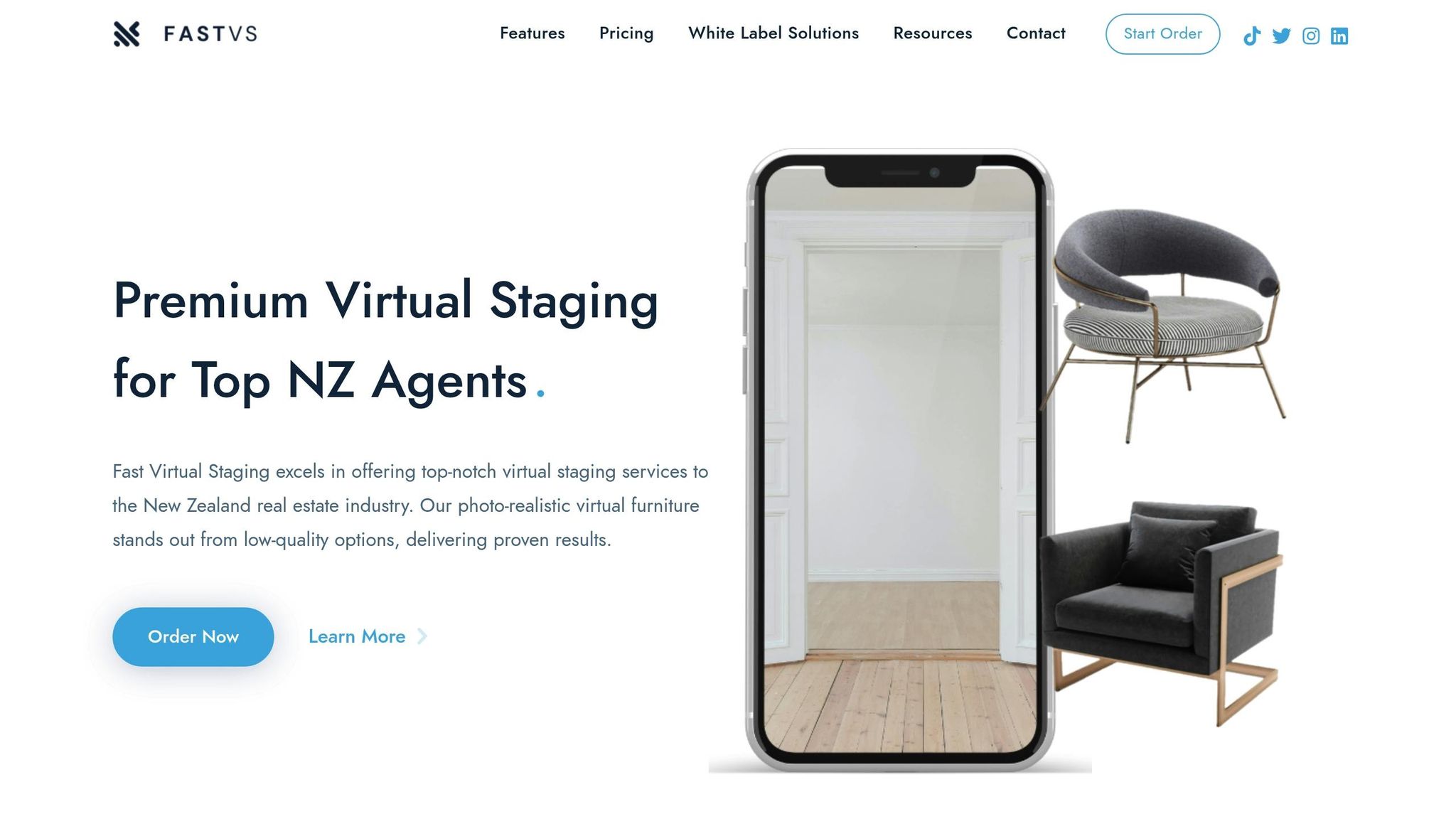
Fast Virtual Staging offers photo-realistic virtual furniture renders with an ordering process that takes less than three minutes. The service boasts a 24-hour turnaround, includes design customisation, and provides two free revisions. Catering to both residential and commercial markets, it offers a variety of design styles to suit a wide range of preferences. Additional perks include a dedicated account manager and white-label solutions with discounted rates for real estate photographers and larger agencies.
Jack Dangerfield from Ray White shared his experience:
"Adding virtual furniture to my property photographs always generates increased interest in my listings. I can choose my own style of furniture and turn‐around times are super‐fast for the quality."
Local Case Studies
Several New Zealand-based case studies highlight how virtual staging has accelerated sales and improved buyer engagement. Brad Minhinnick, Director at LINK Property Management, described how the service benefitted his rental property listings:
"I found the platform easy to use for ordering my digital furniture for empty rooms to give my real estate listings a boost! The services were affordable and I really enjoyed working with my account manager."
Connor Pocock, Sales Associate at Ray White, also praised the service:
"Fast Virtual Staging provides consistently fast turnarounds and high‑quality renders for real estate listings. I’ve recommended to my industry colleagues and will continue to use their services in the future."
In Auckland, a family successfully staged their 1970s bungalow with virtual furniture and sold it above the asking price within two weeks after months of struggling on the market. Meanwhile, in Wellington, virtual staging has proven effective for attracting remote buyers to apartments, often resulting in competitive offers. For real estate photographers, white-label partnerships have been a game-changer, enabling them to offer virtual staging services under their own brand while enjoying discounted pricing.
These examples underscore the impact of virtual staging in boosting property sales and generating buyer interest in New Zealand’s real estate market.
Key Takeaways for Real Estate Professionals
Virtual staging has become a powerful tool for real estate professionals in New Zealand, offering clear advantages in terms of buyer interest, sales speed, and pricing. The numbers speak for themselves: properties with virtual staging sell much faster than vacant ones, giving agents a significant edge in a competitive market.
The financial upside is equally impressive. According to Sotheby’s International Realty, virtually staged properties often sell for 6–10% more than their vacant counterparts. This makes virtual staging a smart investment for agents looking to maximise sale prices.
Buyer engagement also sees a noticeable boost. Listings with virtual staging attract 48% more enquiries and see an 87% increase in online views compared to vacant homes. Considering that over 93% of buyers start their property search online, this increased visibility can make all the difference.
Cost is another area where virtual staging shines. It’s significantly more affordable than traditional staging, costing 75–90% less. The return on investment ranges from 500% to a staggering 3,650%. In New Zealand, a full virtual staging package for an entire home typically costs between NZ$350 and NZ$500. Compare that to traditional staging, which can run anywhere from NZ$1,500 to NZ$4,000.
Virtual staging also offers flexibility. With quick turnaround times, usually within 24 hours, and multiple design options, agents can easily adapt to changing market trends and buyer preferences. Experts estimate a 5–10X return on investment for staging, making it a no-brainer for many agents.
"Staging helps buyers emotionally connect with a home and see its full potential. That connection is often what turns a showing into a sale." – The Look, NZ
Fast Virtual Staging highlights this advantage with its cost-effective services tailored for Kiwi agents. At just NZ$35 per image, with guaranteed 24-hour delivery, two free revisions, and dedicated account management, it addresses the unique challenges of New Zealand’s property market while delivering tangible results.
Virtual staging isn’t just a nice-to-have – it’s a proven, data-driven strategy that helps sell homes faster, at higher prices, and with greater buyer interest. All this, at a fraction of the cost of traditional staging, makes it an indispensable tool for real estate professionals.
FAQs
How does virtual staging compare to traditional staging for selling homes in New Zealand, both in cost and effectiveness?
Virtual staging has become a smart, budget-friendly option for selling homes in New Zealand. Unlike traditional staging, which can cost thousands of dollars and take several days to organise, virtual staging is not only quicker – often completed within a few hours – but also far more affordable, cutting staging expenses by as much as 97%.
When it comes to attracting buyers, virtual staging shines. With most property searches starting online, it allows sellers to present a home’s potential through customised, lifelike designs that grab attention. While traditional staging offers the benefit of a physical, in-person experience, virtual staging provides a faster and cost-effective way to create a lasting first impression, helping properties sell more quickly.
How can sellers ensure their virtual staging aligns with buyer expectations and accurately showcases their property?
To make virtual staging work for potential buyers, it all starts with clear, high-quality photos of the property. The furniture and decor used in the staging should match the style of the home and fit the room dimensions accurately. It’s crucial to resist altering the property’s actual features or structure – buyers may feel let down when they see the home in person if it doesn’t match their expectations.
Being upfront is essential – always let buyers know that virtual staging has been used. This openness helps build trust and ensures buyers have a realistic understanding of what to expect. By sticking to these guidelines, sellers can showcase their property’s possibilities while maintaining honesty.
How does virtual staging help remote or international buyers interested in New Zealand homes?
Virtual staging offers a practical solution for remote or international buyers, enabling them to picture a property’s potential without stepping foot inside. By providing furnished and lifelike images, it allows buyers to grasp the space, layout, and design possibilities more clearly, giving them the confidence to consider sight-unseen purchases.
This approach is especially helpful for overseas buyers dealing with time zone differences or travel limitations. It bridges the gap created by physical distance, making the decision-making process much smoother. Virtual staging highlights a property’s best features, presenting it in a way that’s both engaging and visually appealing – no matter where the buyer is located.