
Virtual staging is transforming how off-plan properties are marketed in New Zealand. Developers use photorealistic renders to show buyers what unbuilt homes will look like, helping them visualise living in the space. This approach addresses a key challenge: buyers often struggle to connect with flat floor plans or architectural drawings. By adding lifelike furniture, décor, and interactive features, virtual staging creates emotional appeal and builds confidence.
Key points:
- Listings with virtual tours get 87% more views, and those with 10–20 images are 45% more likely to be saved on Trade Me.
- Services like Fast Virtual Staging deliver high-quality renders for $35 NZD per image within 24 hours, making it an affordable option for developers.
- Staging focuses on areas Kiwis value most, like open-plan living spaces, outdoor areas, and natural light.
This method not only speeds up buyer decisions but also ensures consistency across marketing materials, from social media to brochures. Virtual staging is a cost-effective way to make off-plan properties more appealing and drive sales.
How Virtual Staging Improves Off-Plan Property Presentation
Using Realistic Images to Reduce Buyer Uncertainty
Virtual staging takes flat architectural drawings and turns them into lifelike, immersive visuals, making it easier for potential buyers to grasp a property’s potential. As Matt Baird, Marketing Manager at Barfoot & Thompson, puts it:
"Buyers can find it hard to read architectural plans, so Realspace helps them understand and visualise the building and views".
A great example of this in action was seen in 2020–2021, when Duo Group and SM Property used highly accurate 3D renders to market units at 112 Purchas Street in Edgeware, Christchurch. The final build closely matched the original renders. This precision reassures buyers, giving them confidence to commit to deposits of 5–10%.
Interactive tools also play a big role. They let buyers experiment with furniture arrangements and finishes, helping them feel more connected to the space. This level of customisation not only brings the property to life but also allows for designs that align with Kiwi preferences.
Adapting Visuals for New Zealand Buyer Preferences
Beyond clear visuals, tailoring imagery to reflect Kiwi tastes is key. New Zealand buyers often lean toward natural, understated designs – think soft colour palettes and materials like wood, sandstone, and concrete. Open-plan layouts are another favourite, especially when they link living, dining, and kitchen areas, with large windows letting in plenty of morning light. For buyers prioritising quality, showcasing features like a 6 Homestar rating, which signifies excellent insulation and moisture control, can enhance a property’s appeal.
Displaying Features That Match Kiwi Lifestyle
Virtual staging also shines when it comes to highlighting the indoor–outdoor living that’s so central to the Kiwi lifestyle. Staged visuals often include inviting outdoor furniture, potted plants, and setups for barbecues or reading nooks.
Incorporating lifestyle-focused spaces – like home offices, sunny reading corners, or outdoor entertaining areas – can make all the difference. These touches not only resonate with buyers but can also increase sale prices by 10–15%. By turning abstract floor plans into warm, liveable spaces, virtual staging helps buyers picture their lives unfolding in these homes.
Planning Your Virtual Staging Strategy
Choosing Which Spaces to Stage
Focus on the spaces that resonate most with Kiwi buyers: the living room, kitchen and dining area, master bedroom, and outdoor spaces like decks or courtyards. These are the spots where potential buyers imagine hosting BBQs, sipping their morning coffee, or winding down after a long day. Homes in New Zealand that are professionally staged often sell for 10% to 15% more than their unstaged counterparts and can sell in half the usual time. By prioritising these key areas, you can create a seamless and appealing visual story.
Consider your target audience when deciding how to stage. For young families, a spare room staged as a nursery can be a great touch. For professionals, a stylish home office setup might be more appealing. Use staging to emphasise the unique architectural features of the home – whether it’s high ceilings, large windows that let in natural light, or breathtaking views. Just ensure that the furniture is appropriately sized for the room; oversized pieces can make even the most spacious areas feel cramped.
Providing Information to Fast Virtual Staging
To bring your vision to life, clear and detailed inputs are essential. Share high-resolution renders and floor plans (measured in square metres) to ensure the furniture is scaled accurately for New Zealand homes. Be specific about the lifestyle moments you want to highlight – whether it’s enjoying a sunny balcony with a cup of coffee or hosting friends in a spacious, open-plan living area.
Request neutral tones with pops of colour and light materials like linen to create the bright, airy feel that appeals to Kiwi buyers. For outdoor areas, include details like BBQs, outdoor dining settings, and greenery to highlight the indoor-outdoor flow that’s so valued here. The more precise you are about the style – be it Scandi, Modern, or Coastal – and the demographics you’re targeting, the better the results from Fast Virtual Staging will align with your vision.
Maintaining Consistency Across Multiple Units
Once your staging strategy is set, focus on ensuring a cohesive design across all units. Choose a unified design theme, such as Scandinavian, Coastal, Modern, or Hamptons, and apply it throughout the development. Stick to neutral colour schemes like soft grey, beige, or off-white as a base. This not only creates a harmonious flow between units but also appeals to a broad range of buyers.
Fast Virtual Staging helps maintain uniformity in image quality, lighting, and rendering styles across the entire project. While keeping a consistent aesthetic, you can still showcase flexibility by staging spare rooms differently – one as a bedroom, another as a study – to highlight the versatility of the spaces. This approach not only keeps the overall design polished but also helps buyers imagine themselves living in the space.
Creating Staged Visuals with Fast Virtual Staging
Preparing Your Base Images
Fast Virtual Staging makes it easy to get started with high-quality visuals. Begin with high-resolution images, whether taken with professional cameras or modern smartphones. For off-plan projects that haven’t been constructed yet, use 3D architectural renders as your starting point. These renders act as a blank slate, allowing buyers to imagine the finished property before construction even begins.
For exterior shots, drone photography is a great way to showcase the property’s surroundings. Enhance these images with "Day to Dusk" editing, which transforms daytime shots into elegant twilight scenes, adding a touch of sophistication to your marketing materials. If you’re working with photos of a finished but empty property, ensure the space is tidy – remove any construction debris, bins, or other distractions. For New Zealand developments, focus on angles that highlight indoor-outdoor flow, such as decks, courtyards, and transitions to outdoor spaces. These features are particularly appealing to Kiwi buyers. Once your base images are ready, provide clear instructions to guide the staging process.
Submitting Instructions and Reviewing Results
Clear communication is key to achieving the perfect result. When submitting instructions, describe specific lifestyle scenarios you want to portray, such as a cosy movie night or a relaxed breakfast setting.
Define your desired design style upfront – whether it’s Scandinavian, Modern, or Coastal – and include a clear colour scheme, like neutral tones with accents of dark navy blue. Be specific about furniture choices, such as requesting an "L-shaped sectional" or a "minimalist wooden TV unit." To keep the space visually appealing, set limits on décor, for example, "no more than three plants". Fast Virtual Staging provides a 24-hour turnaround and offers two free revisions, so you can fine-tune the visuals until they align perfectly with your vision. Use their markup tools to ensure every detail meets your expectations.
Staging Features That Appeal to New Zealand Buyers
When staging for New Zealand buyers, focus on features that resonate with their lifestyle. Highlight natural light by choosing light, airy window coverings like linen and avoid placing virtual furniture where it might block sunlight. Emphasise indoor-outdoor flow with inviting outdoor furniture and subtle design touches that connect the interior to outdoor spaces.
During New Zealand’s humid summers, features like heat pumps or open windows can visually communicate a cool, comfortable living environment. Practicality is also a priority for Kiwi buyers – stage wardrobes, pantries, or built-in storage to showcase how the home supports everyday life. Stick to a neutral aesthetic to help potential buyers imagine themselves in the space.
At just $35 NZD per image, Fast Virtual Staging offers a cost-effective alternative to traditional staging, which typically ranges from $1,500 to $2,500 for a four-week period. These thoughtful staging details ensure the final visuals reflect the practicality and relaxed lifestyle that New Zealand buyers value most.
Using Staged Visuals Across Marketing Channels
Adding Staged Images to Property Listing Websites
When showcasing properties in New Zealand, Trade Me Property is your go-to platform. It’s the leading property site in the country, making it the perfect place to feature your staged visuals. To stand out, upload high-resolution images that grab attention. While conventional real estate photos often focus on wide-angle room shots, try mixing in lifestyle images. For example, a beautifully set dining table or a cosy home office by the window can help buyers imagine themselves living in the space. These details create a narrative, showing how the property can fit into their lives.
For off-plan developments, high-quality renders are a must. Optimise these for both print and digital formats to help buyers quickly visualise the finished property.
Using Staged Content on Social Media and Project Websites
Social media is a powerful tool to amplify your staged visuals. With over 70% of New Zealanders on Facebook as of April 2020, it’s a critical channel for reaching buyers. But here’s the catch: standard real estate photos often fail to grab attention as users scroll through their feeds. Howard John, NZ Sales Manager at Diakrit, explains:
"If you show social media users a typical real estate photo while they are scrolling through their newsfeed, they will most likely dismiss it… But if you use a lifestyle photo, it adds an element of emotion that will capture their attention".
To stop the scroll, lead with lifestyle-focused visuals. Think of a cosy reading nook or a styled outdoor BBQ area – these moments evoke emotion and stand out more than generic room shots.
On your project website, take it a step further with interactive elements. Allow buyers to personalise spaces by changing things like floor colours or kitchen finishes. Listings that include interactive tools and professional photography often see double the engagement time compared to traditional listings. For off-plan projects, prominently feature 3D virtual tours. These tours let buyers explore layouts at their own pace, easing the uncertainty that comes with buying from a plan. These digital tools not only extend the reach of your staged visuals but also enhance the property’s overall appeal.
Including Staged Images in Display Suites and Printed Materials
Your physical marketing materials should align seamlessly with your digital strategy. For brochures or banners in display suites, always use high-resolution images to maintain a polished and professional look. Avoid relying solely on standard room shots; instead, include lifestyle-focused images that resonate with Kiwi buyers. For instance, a sunny courtyard with a book or a styled breakfast counter can evoke feelings of comfort and familiarity.
In display suites, before-and-after visuals are particularly effective. They can highlight the transformation of empty spaces or basic renders, helping buyers see the property’s full potential. As Vive Business notes:
"Most people struggle to visualise their future purchase and develop an emotional connection to a new property from a two dimensional drawing".
For properties still under construction, consider incorporating virtual reality (VR) experiences into your display suite. VR can bridge the gap that flat floor plans often leave, creating a stronger emotional connection with buyers. If you’re using QR codes in printed materials to link to virtual tours, make sure the content is mobile-friendly and loads quickly. These strategies ensure your staged visuals leave a lasting impression, both online and offline.
sbb-itb-7b8b2a2
Virtual Staging with AI – How Realtors Use Artificial Intelligence to Sell Homes Faster
Measuring Results and Improving Future Projects
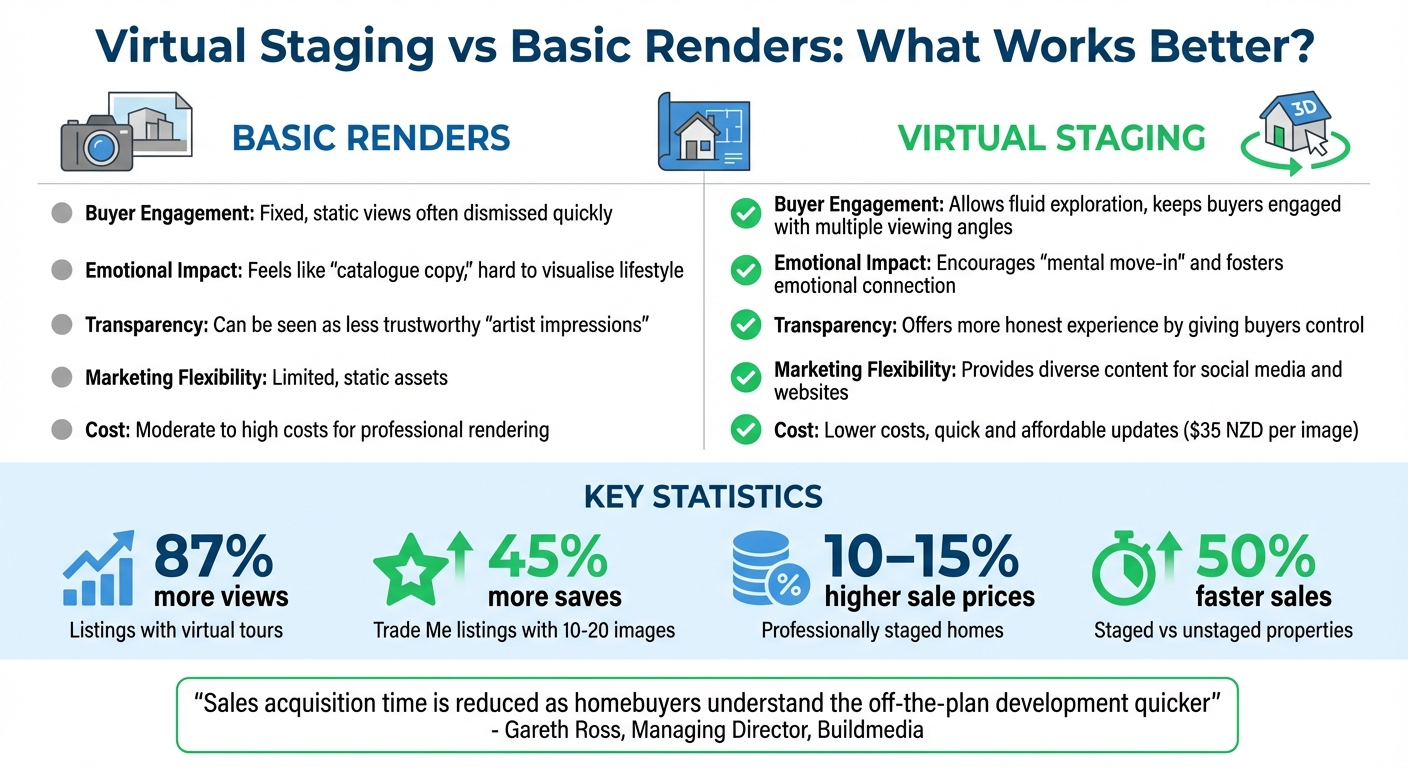
Virtual Staging vs Basic Renders: Performance Comparison for NZ Property Developers
Tracking Metrics to Measure Performance
Start by analysing how long potential buyers spend engaging with your property listings. Tools like virtual tours and digitally staged spaces are designed to hold their attention longer, creating a more immersive experience. Compare performance across platforms – evaluate enquiries from social media channels like Facebook against more traditional property portals.
Keep an eye on both cost and time efficiency. Measure how quickly you can produce marketing materials and assess buyer feedback on how well they can visualise themselves living in the space. This emotional connection is a key objective of virtual staging. Conversion rates are another critical metric – compare off-plan sales achieved with virtual staging to those using only basic renders.
Using direct buyer feedback can help fine-tune your approach further.
Using Feedback to Improve Future Staging
Your sales team is a treasure trove of insights. They can pinpoint which features – like a specific kitchen layout or unique lighting in a bedroom – resonate most with buyers when using staged visuals during meetings. Use this information to prioritise those elements in future projects, ensuring a more targeted and effective staging strategy. This feedback loop not only improves consistency but also speeds up decision-making.
Experiment with different design styles to identify what clicks with your audience. For instance, compare "natural minimalism" with "industrial" aesthetics to see which aligns better with your target demographic, all without the expense of physical staging. On social media, track engagement to discover which "lifestyle" hooks perform best. A staged home office with a tagline like "skip Auckland traffic" might generate more interest than a generic living room shot. Tools like heatmaps can also reveal which visuals draw the most attention on your project website.
Comparing Virtual Staging to Basic Renders
The data makes the difference clear: listings with virtual tours get 87% more views than those without. On Trade Me Property, listings featuring 10 to 20 images are saved to watchlists at least 45% more often than those with fewer images.
| Feature | Basic Renders | Virtual Staging |
|---|---|---|
| Buyer engagement | Fixed, static views often dismissed quickly | Allows fluid exploration, keeping buyers engaged with multiple viewing angles |
| Emotional impact | Feels like "catalogue copy", making it hard to visualise a lifestyle | Encourages a "mental move-in" and fosters emotional connection |
| Transparency | Can be seen as less trustworthy "artist impressions" | Offers a more honest experience by giving buyers control over what they see |
| Marketing flexibility | Limited, static assets | Provides diverse content for social media and websites |
| Cost | Moderate to high costs for professional rendering | Lower costs, allowing for quick and affordable updates |
Gareth Ross, Managing Director at Buildmedia, highlights the advantage:
"Realspace is an interactive digital display suite… that showcases and sells off-the-plan property… sales acquisition time is reduced as homebuyers understand the off-the-plan development quicker".
Barfoot & Thompson tested interactive virtual tools in seven Auckland branches, reporting "outstanding" results before expanding to all 75 branches. This phased approach demonstrates the value of testing and refining strategies based on actual performance data.
Conclusion: How Virtual Staging Supports Off-Plan Sales
Virtual staging tackles the challenges of off-plan sales by helping buyers picture a property that hasn’t been built yet. Instead of relying on static 2D floor plans, photorealistic renders with detailed furniture arrangements and finishes bring these spaces to life. This allows buyers to imagine themselves living in the property, creating an emotional connection that makes decisions easier and boosts their confidence.
The impact is clear in the numbers. Listings featuring virtual tours receive 87% more views, and Trade Me listings with 10 to 20 images see a 45% increase in watchlist saves. Gareth Ross from Buildmedia highlights this advantage:
"A recurring comment from the sales teams we’ve worked with is that sales acquisition time is reduced as homebuyers understand the off-the-plan development quicker."
Another major benefit is transparency. Interactive 3D models and renders provide precise representations of what buyers can expect, including accurate exterior views captured through drone photography. This level of detail builds trust in a way that traditional artist impressions often fail to achieve. As Matt Baird from Barfoot & Thompson explains:
"Buyers can find it hard to read architectural plans, so Realspace helps them understand and visualise the building and views… they really feel they understand the spaces."
Virtual staging also streamlines marketing efforts. A single set of digital assets can be repurposed across websites, social media, brochures, and display suites, ensuring a consistent brand message that strengthens buyer trust. Fast Virtual Staging offers this service at just $35 NZD per image, delivering high-quality renders in as little as 24 hours – a practical and affordable solution for all types of developments.
FAQs
How does virtual staging help buyers feel confident about purchasing off-plan properties?
Virtual staging breathes life into basic floor plans by turning them into fully furnished, realistic visuals. By digitally incorporating furniture, décor, and finishes, these images highlight the scale, layout, and functionality of a property, helping potential buyers picture themselves living in the space.
This highly detailed approach eases uncertainty by offering a clear glimpse of the finished home. Buyers can visualise a kitchen complete with appliances or a perfectly arranged living room, fostering an emotional connection and a sense of trust. This added clarity often encourages quicker decisions and boosts confidence when purchasing off-plan properties.
What should Kiwi property developers prioritise when virtually staging homes for off-plan projects?
To resonate with Kiwi buyers, realistic and high-quality visuals are crucial. Virtual staging should start with professional photos as a foundation, enhanced with digitally added furniture and décor that look lifelike. These elements must be accurately scaled using metric measurements and rendered with natural lighting for authenticity. Incorporating design elements that reflect New Zealand’s style – think clean lines, timber accents, and a relaxed, neutral colour palette – can help buyers picture themselves living in the space.
Another important advantage is adaptability. Virtual staging makes it simple to tweak styles, swap out furniture, or emphasise specific property features without the expense of physical staging. Adding interactive elements like floor plans or 360° views with realistic colours and sharp visuals creates a more engaging experience. Combined, these features build confidence, capture buyer interest, and can speed up off-plan property sales in the New Zealand market.
How does virtual staging compare to traditional staging in terms of cost?
Virtual staging is a much more budget-friendly option compared to traditional staging, as it cuts out the need for physical furniture, transportation, and labour. In New Zealand, traditional staging often comes with hefty costs – renting furniture, hiring movers, and even making minor renovations can quickly add up to thousands of dollars per property. Virtual staging, however, takes a different approach. It digitally places life-like furniture into property photos for a flat fee, usually around NZ$35 per image, making it an affordable alternative.
There’s also the added benefit of flexibility and time efficiency. With virtual staging, you can easily tweak furniture styles, adjust layouts, or update decor without incurring extra costs or dealing with the logistical headaches of physical staging. This hassle-free method not only helps cut costs but can also boost buyer interest and speed up sales, making it a savvy option for developers and agents, especially when marketing off-plan projects.