
Virtual staging is transforming New Zealand’s property market by helping homes sell faster and for higher prices. This digital technique adds furniture and décor to photos of empty rooms, creating inviting visuals that attract buyers online. It’s cost-effective, with prices starting at NZ$24–35 per image, compared to over NZ$1,500 for physical staging. Listings with staged images often sell 30–50% faster and can achieve price increases of 5–10%.
Key points:
- Affordable: Virtual staging costs under NZ$100 per image.
- Fast: Images are delivered within 12–48 hours.
- Effective: Staged homes sell quicker and for more money.
- Tailored for NZ: Styles cater to urban apartments in Wellington and luxury homes in Queenstown.
With 93% of Kiwi buyers beginning their property search online, virtual staging is a practical way to make listings stand out and connect with potential buyers.
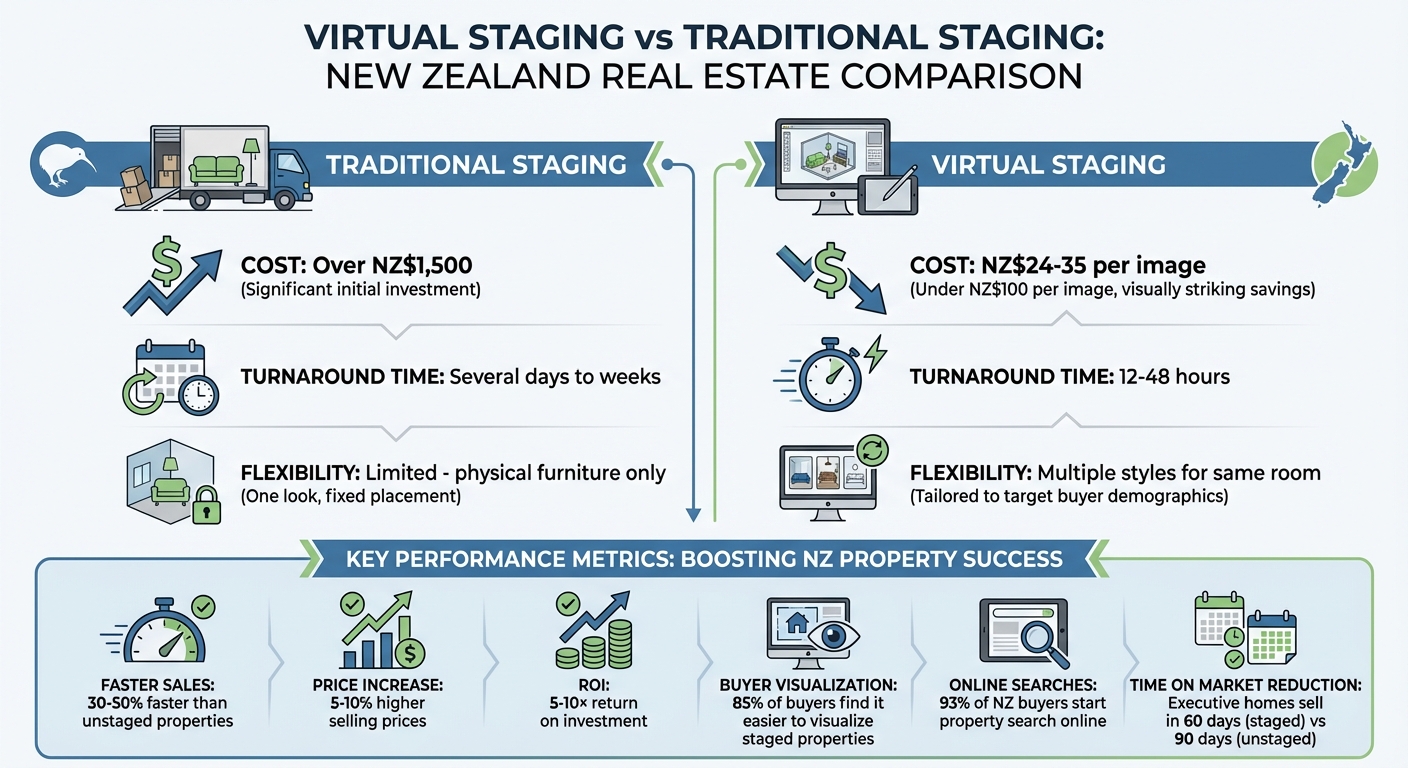
Virtual Staging vs Traditional Staging: Cost and Time Comparison in New Zealand
Incorporating AI in Real Estate Videos (Virtual Staging and More!)
What is Virtual Staging in New Zealand Real Estate?
Virtual staging is a digital technique that uses CGI to add furniture and décor to photos of empty properties. Within just 48 hours, you can have staged images that help buyers imagine how a house could feel like a home. This is especially useful for buyers who struggle to picture how an empty room could be transformed into a warm, inviting space.
Unlike traditional staging, virtual staging offers unmatched flexibility. A single room can be styled in multiple ways – think of a spare bedroom being shown as a cosy nursery for young families or a practical home office for professionals. Some agents are even taking it a step further by showcasing "virtual renovations", illustrating how outdated kitchens or bathrooms could look after modern updates.
This digital approach is reshaping how properties are marketed across New Zealand, from Wellington’s city apartments to Queenstown’s luxurious chalets.
Why Virtual Staging Works in NZ’s Property Market
With over 90% of property searches in New Zealand now starting online, platforms like Trade Me, OneRoof, and realestate.co.nz have become the first stop for buyers. In this competitive digital space, a property’s photographs are its first impression, and listings with striking images are far more likely to attract attention and generate enquiries.
"More than 90 percent of property journeys start online, and that is where quality pictures capture an audience to stand out from the competition."
- Lyall Russell, LJ Hooker
Today, high-quality digital imagery is a must. Enhancements like adding stylish furniture, adjusting lighting, eliminating clutter, or even showcasing twilight skies have become standard practice in New Zealand. Regional preferences also influence staging styles: Wellington buyers often lean towards sleek, space-efficient designs suited for urban apartments, while Queenstown’s luxury market demands lavish styling to attract both international investors and buyers seeking high-end holiday homes. Understanding these regional dynamics is key to making virtual staging work effectively.
Main Benefits for Sellers and Real Estate Agents
Virtual staging offers a cost-effective solution, priced at under NZ$100 per image – up to 90% cheaper than traditional staging – and delivers results in less than 48 hours. This speed and affordability not only streamline sales processes but also boost property performance across various markets, including Wellington and Queenstown.
Studies indicate that 85% of buyers find it easier to visualise a property when it’s staged. Staged homes in New Zealand are also proven to sell 30% to 50% faster than their unstaged counterparts. For real estate agents, this means quicker sales, happier clients, and more efficient marketing budgets – all of which help turn online browsers into serious buyers.
Virtual Staging for Wellington Properties
Selling property in Wellington comes with its own set of challenges. With the median time to sell sitting at 46 days and a high volume of listings competing for attention, it’s crucial for properties to grab interest right away – especially online. From compact city apartments to spacious suburban homes, Wellington’s diverse property market demands tailored marketing strategies. This is where virtual staging has become an essential tool, helping sellers and agents navigate the city’s competitive real estate landscape.
Appealing to Wellington’s Urban Buyers
Urban properties in Wellington, particularly apartments, often face what industry professionals call "empty room syndrome." As property adviser Ed McKnight points out, "Rooms without furniture tend to feel smaller than they really are, and buyers struggle to imagine if they really could fit their queen-sized bed into that bedroom". Virtual staging solves this by adding digital furniture that’s perfectly scaled to the space. This not only shows how rooms can be used but also helps define areas in open-plan layouts, making them feel more functional.
For Wellington’s professionals and students, who often prioritise compact living spaces, virtual staging can transform an apartment by showcasing distinct areas for living, dining, or even working. For example, a small alcove can be digitally styled as a practical home office. Compared to traditional staging methods, this is a much more cost-effective solution, appealing to buyers who, in 2026, are increasingly drawn to "move-in ready" properties.
Virtual staging also taps into what McKnight describes as "presenting a fresh, homely, somewhat spare canvas onto which buyers can project the fantasy of their own best life". In a market where the median house price is NZ$767,500, this approach can make all the difference, helping listings stand out and sell faster.
Example: A Modern Wellington Apartment
Take a typical two-bedroom apartment in Te Aro as an example. When photographed empty, its bare walls and undefined spaces might leave potential buyers unsure of how to use the space. By digitally adding minimalist Scandi-style furniture, agents can show how the main living area comfortably fits a sofa, coffee table, and dining set without feeling cramped. The second bedroom could be styled as a sleek home office or a cosy guest room, catering to different buyer needs.
This flexibility is especially useful in Wellington’s recovering rental market, where demand has risen by 16% thanks to the return of students and professionals. Well-staged properties also tend to generate more online interest, with virtual staging allowing agents to prepare listings in just 24–48 hours. This quick turnaround ensures properties hit the market at the right time, maximising visibility during peak browsing periods.
Marketing Queenstown’s High-End Properties
In New Zealand’s property market, where digital-first strategies dominate, virtual staging has become a game-changer for Queenstown’s luxury real estate. With many potential buyers coming from outside the region – or even overseas – properties need to make an instant impression online. Virtual staging is proving to be a powerful tool, enabling agents to showcase chalets and holiday homes in a way that captivates remote buyers who might never set foot inside the property before making an offer.
Reaching Queenstown’s Tourism and Investment Market
For buyers in Auckland, Sydney, or Singapore, decisions often hinge on digital images alone. This makes high-quality virtual staging essential. Jack Dangerfield from Ray White explains, "Adding virtual furniture to my property photographs always generates increased interest in my listings. I can choose my own style of furniture and turn‐around times are super‐fast for the quality".
When it comes to luxury properties, the quality of staging is non-negotiable. Queenstown’s high-end homes demand digitally rendered furniture that matches their premium appeal – not generic or poorly executed visuals that could diminish the property’s allure. The goal is to transform empty spaces into inviting interiors while keeping the spotlight on Queenstown’s breathtaking natural scenery. Furniture placement must be carefully planned to ensure pieces don’t overshadow views of Lake Wakatipu or the Remarkables.
Staging also has a measurable impact on market performance. Executive-level homes in New Zealand typically remain on the market for 90 days when left unstaged. However, staging can cut this time to just 60 days. For Queenstown properties priced in the millions, this 30-day reduction can mean significant savings in holding costs. Virtual staging is especially practical in a resort town like Queenstown, where physically staging a property can be both costly and logistically challenging due to the remote locations and high transport expenses. This digital solution offers a seamless way to enhance marketability.
Example: A Queenstown Luxury Chalet
Here’s how virtual staging can elevate a property’s appeal: imagine a four-bedroom alpine chalet in Arrowtown with sweeping mountain views. Photographed as-is, the empty rooms might feel cold and uninspiring, making it hard for buyers to visualise the potential. With virtual staging, contemporary furnishings can be added to highlight the chalet’s luxury, strategically placed to frame the stunning vistas. Open-plan areas can be defined, and bedrooms styled with warm textures to create an inviting atmosphere.
For Queenstown’s market, an "après-ski" theme resonates strongly. Virtual fireplaces, plush throws, and modern alpine furniture help evoke the luxurious mountain lifestyle buyers are looking for. Fast Virtual Staging offers quick turnaround times and cost-effective solutions, allowing agents to prepare a luxury listing in no time. They even provide two free revisions to ensure the final product meets the high standards expected for premium properties. With options to select specific design styles – whether Scandinavian minimalism or French Country elegance – each property can be tailored to attract its ideal buyer. These techniques consistently enhance visual appeal and drive better results across New Zealand’s luxury real estate market.
sbb-itb-7b8b2a2
Fast Virtual Staging Features for NZ Real Estate Professionals
Fast Virtual Staging caters specifically to New Zealand’s real estate market. It delivers photo-realistic 3D renders crafted by skilled artists – steering clear of lower-quality AI-generated results. Designed to assist real estate agents, property managers, and photographers, the service offers pricing in NZ dollars and design styles that appeal to local buyer preferences. This makes property marketing faster and more effective.
Fast Virtual Staging: What’s Included
For just $35 NZD per image, the service promises delivery within 12–24 hours. If they miss the deadline, the order is free. Each project also includes two free revisions, ensuring the final images align with your marketing vision. With a variety of design styles like Scandinavian, Modern, and French Country, agents can customise the look to suit the property’s target audience. Plus, every order comes with a dedicated account manager to oversee the process and handle any adjustments.
Brad Minhinnick, Director at LINK Property Management, shared his experience:
"I found the platform easy to use for ordering my digital furniture for empty rooms to give my real estate listings a boost! The services were affordable and I really enjoyed working with my account manager."
How Fast Virtual Staging Streamlines Property Marketing
The process is quick and user-friendly. Agents can upload photos, choose a design style, and receive polished renders via email – all in under three minutes. Photographers can also take advantage of white-label solutions, offering staging services under their own brand. Members of the Real Estate Photographer Club even enjoy an exclusive 20% discount.
Connor Pocock, Sales Associate at Ray White, said:
"Fast Virtual Staging provides consistently fast-turnaround and great quality virtual furniture for real estate listings."
Fast Virtual Staging Features and Benefits
Here’s a quick breakdown of the service’s key features and how they’re tailored for New Zealand:
| Feature | Benefit | NZ-Specific Adaptation |
|---|---|---|
| Pricing | Affordable at $35 NZD per image | Clear pricing in NZ dollars, reflecting local market expectations |
| Delivery Time | 12–24 hour turnaround | Perfect for NZ’s fast-paced auction and deadline-driven sales culture |
| Design Styles | Options like Scandinavian, Modern, and French Country | Matches NZ architectural trends and buyer tastes |
| White-Label Solutions | Custom branding for agents and photographers | Supports NZ photographers with a 20% discount |
| Revisions | Two free revisions per project | Ensures images meet local buyer preferences |
| Support | Dedicated account manager | Personalised assistance for property-specific needs |
The service isn’t limited to residential interiors – it also handles exteriors and commercial spaces like offices, retail outlets, and industrial properties. This versatility makes it an essential tool for New Zealand’s diverse property market.
Legal and Ethical Requirements for Virtual Staging in NZ
When it comes to virtual staging in New Zealand, transparency isn’t just a good practice – it’s a legal obligation. Real estate professionals must ensure that all marketing materials present properties accurately and honestly. According to the Real Estate Authority (REA), advertisements should generate interest without misleading potential buyers. This aligns with key legislation, including the Fair Trading Act 1986, the Real Estate Agents Act 2008, and the Professional Conduct and Client Care Rules 2012. These laws require that all claims made in property marketing are based on solid evidence. Violating these laws – such as making unsubstantiated claims under sections 12A and 40 of the Fair Trading Act – can lead to fines of up to $200,000 for individual agents and $600,000 for agencies.
"While it is not expected everything about a property or business is disclosed in the advertising, you should ensure that the impression the marketing gives is a correct reflection of the property or business being marketed." – Real Estate Authority
These legal requirements form the foundation for ethical virtual staging practices.
To comply, ensure all virtually staged images are clearly labelled as digitally enhanced. This helps prevent any confusion or misinterpretation by potential buyers. Additionally, secure written approval from vendors for all marketing materials and have a supervisor review the images for accuracy. If any issues are discovered after publication, immediately withdraw the materials and inform all relevant parties.
It’s also crucial to maintain thorough records of all buyer communications. Encourage buyers to conduct in-person inspections and seek professional advice. With over 93% of New Zealand property buyers starting their search online, ensuring the accuracy of visuals is essential – not just for building trust but also for staying on the right side of the law.
Conclusion
Virtual staging is reshaping the way properties are presented across New Zealand, from Wellington’s bustling apartments to Queenstown’s elegant chalets. By addressing the challenge of empty or outdated spaces, it helps potential buyers imagine the possibilities a property holds. Considering that 93% of Kiwi buyers begin their property search online, having visually appealing and professional images is crucial for sparking interest and securing viewings.
Fast Virtual Staging offers a solution that combines speed and affordability. With a 24-hour turnaround and a price of just $35 NZD per image, it’s an accessible option for property sellers. The service also includes two free revisions and a dedicated account manager to ensure the final results align with market expectations.
The benefits of virtual staging go beyond convenience. For mid- to high-end properties, it delivers a return on investment of 5–10×, turning online interest into in-person viewings and, ultimately, sales. As staging expert The Look explains:
"Staging helps buyers emotionally connect with a home and see its full potential. That connection is often what turns a showing into a sale" – The Look, NZ
Whether you’re marketing a sleek new build in Wellington or a luxury investment property in Queenstown, virtual staging provides a practical and cost-effective alternative to traditional staging. It allows you to showcase different design styles effortlessly and adapt your marketing materials as trends shift, making it an invaluable tool for meeting the changing demands of New Zealand’s property market.
FAQs
What are the cost and effectiveness differences between virtual staging and traditional staging?
Virtual staging offers a much more budget-friendly alternative to traditional staging. While virtual staging costs around NZ$35–$65 per image or approximately NZ$175 for a three-bedroom home, traditional staging can set you back anywhere from NZ$1,500 to over NZ$5,000 per property. These higher costs for traditional staging include expenses like furniture rental, delivery, and set-up. Thanks to its lower price point, virtual staging delivers a significantly higher return on investment (ROI) – ranging from 500% to 3,650%, compared to the 102% to 909% ROI typically seen with traditional staging.
Both methods can increase sale prices by 5%–10%, but virtual staging often has the edge when it comes to speed. Digitally staged homes tend to sell up to three times faster, often closing 17–30 days sooner on average. Without the hassle of transporting and arranging physical furniture, virtual staging provides a streamlined and efficient way to elevate property listings in New Zealand.
What rules apply to using virtual staging in New Zealand real estate marketing?
In New Zealand, virtual staging is permitted, but it comes with strict guidelines set by the Real Estate Authority (REA). According to the Real Estate Agents Act 2008, all digitally altered images must be clearly marked as “virtually staged”. This ensures transparency and prevents misleading potential buyers.
Real estate agents are responsible for ensuring that virtual staging does not distort a property’s size, layout, or permanent features. Additionally, they are required to maintain records of both the original and virtually staged images. Ignoring these rules could lead to breaches of the REA Code of Conduct, potentially resulting in disciplinary consequences.
To remain compliant, always label virtually staged images, present the property’s condition accurately, and adhere to the REA’s standards for ethical marketing.
How can virtual staging be customised for different regions like Wellington and Queenstown?
Virtual staging can be customised to match the distinct lifestyles and design tastes of various regions. Take Wellington, for instance. With its focus on compact city living, showcasing sleek, space-efficient furniture and neutral colour palettes can make a strong impression. Incorporating elements like built-in desks, minimalist lighting, and subtle coastal touches can emphasise the practicality and contemporary charm of smaller urban spaces.
Meanwhile, in Queenstown, where many buyers are drawn to holiday homes or investment properties, virtual staging can bring the region’s alpine allure to life. Think warm timber furnishings, soft rugs, and outdoor features like fire pits or deck seating. These touches create a cosy, welcoming vibe that complements Queenstown’s stunning natural surroundings.
By tailoring décor to local tastes, virtual staging not only helps buyers picture their dream lifestyle but also gives sellers an edge in a competitive market.