
Selling a home in New Zealand? Virtual staging could be your secret weapon. Unlike traditional staging, which costs anywhere from NZ$1,500 to NZ$2,500 and takes weeks to arrange, virtual staging is faster, cheaper, and delivers stunning results. For just NZ$35 per image, you can transform empty rooms into inviting, stylish spaces that attract buyers online and boost sale prices by 10–15%. With 90% of buyers starting their search online, high-quality, eye-catching photos are non-negotiable. Virtual staging delivers polished images in as little as 24 hours, helping your property stand out in a competitive market. Whether you’re selling a vacant home, a dated villa, or a commercial space, this approach makes your listing shine – without the hassle or expense of physical staging.
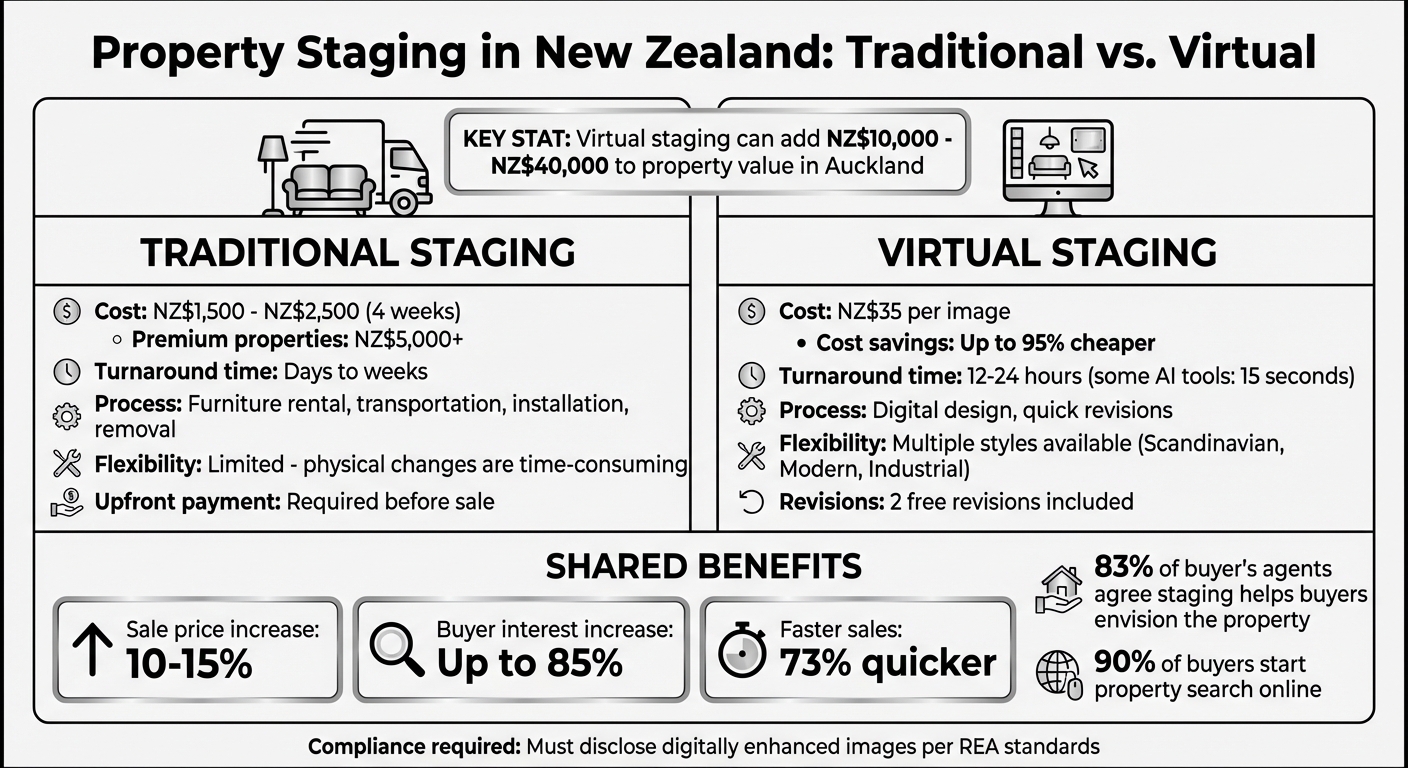
Traditional vs Virtual Staging Costs and Benefits in New Zealand
Problems with Traditional Property Staging in NZ
While traditional property staging can help boost sale prices, it often brings financial and logistical hurdles for sellers in New Zealand. These challenges have paved the way for virtual staging as a more flexible option.
High Costs of Physical Staging
One of the biggest drawbacks of traditional staging is the hefty upfront cost. In New Zealand, staging a home typically costs between NZ$1,500 and NZ$2,500 for a four-week period, with premium services for larger properties climbing above NZ$5,000. These fees cover furniture rental, styling services, transportation, installation, and eventual removal.
"Professional staging services and furniture rental can add up, and for some sellers this upfront investment might not be within their budget." – realtor.co.nz
For some sellers, the cost of staging can equal around 1% of the property’s sale price, which can be a significant expense, especially for those on tight budgets. Adding to the financial strain, these fees must be paid upfront – unlike agent commissions, which are only due after the property is sold. If the staging period needs to be extended, the costs rise further, and any delays in the process can hinder buyer interest. Beyond the expense, the coordination required for traditional staging adds another layer of complexity.
Logistics and Time Delays
In addition to the financial burden, traditional staging often involves time-consuming logistics. Sellers need to juggle schedules between staging companies, real estate agents, and photographers. This process can take days or even weeks, especially when factoring in the necessary prep work like decluttering, depersonalising, making minor repairs, and deep cleaning.
"Preparing a property for professional staging takes time. In fast-moving markets, this could mean missing out on immediate sale opportunities." – Realtor.co.nz
The physical task of moving furniture in and out of the property further adds to delays. If adjustments are needed to appeal to different types of buyers, the process can take even longer, sometimes adding several more days. These logistical challenges can make traditional staging a less appealing choice for sellers looking to act quickly in competitive markets.
How Virtual Staging Addresses Real Estate Challenges
Virtual staging offers a smart alternative to traditional property staging. Instead of renting and arranging physical furniture, property owners collaborate with digital designers to create photo-realistic images of furnished spaces. These enhanced images help potential buyers imagine the possibilities of a property without the hassle of physical staging. Here’s how virtual staging tackles the common challenges of traditional methods.
Lower Costs and Faster Results
In New Zealand, traditional staging can cost between NZ$1,500 and NZ$2,500 for just four weeks. In contrast, virtual staging is far more budget-friendly. For example, Fast Virtual Staging charges only NZ$35 per image, delivers final images within 12–24 hours, and even includes two free revisions. This makes it a far quicker and cheaper solution. Some AI-powered tools can produce ready-to-use images in as little as 15 seconds, compared to the days or even weeks required for physical staging. Overall, virtual staging can be up to 95% cheaper than its traditional counterpart.
Showcasing a Property’s Potential
Empty rooms often leave buyers struggling to picture how they’d use the space. Virtual staging solves this by adding digital furniture and décor, showcasing the property’s best features. Sellers can customise the design to match popular styles that resonate with their target market. Even properties in need of significant work can be digitally transformed to highlight their potential – without requiring expensive renovations.
Adhering to NZ Real Estate Advertising Standards
Virtual staging must meet the Real Estate Authority‘s (REA) standards to ensure ethical marketing. The REA requires that all digitally enhanced images are clearly disclosed to buyers, ensuring transparency and compliance with the Fair Trading Act 1986. This means property listings must include a disclaimer stating that the furniture is digitally added. Such disclosures protect both buyers and sellers by managing expectations. Failure to comply can lead to fines of up to NZ$200,000 for individuals.
"While it is not expected everything about a property or business is disclosed in the advertising, you should ensure that the impression the marketing gives is a correct reflection of the property or business being marketed."
– Real Estate Authority (REA)
Main Benefits of Virtual Staging in NZ
In New Zealand, virtual staging has become a go-to solution for property owners and real estate professionals. Why? It boosts listing performance, works quickly when time is tight, and suits a wide range of properties and budgets.
Enhancing Buyer Interest with Eye-Catching Photos
Staging plays a key role in helping buyers picture themselves in a home, with 83% of buyer’s agents agreeing that it makes a difference. Virtual staging takes this to the next level, turning empty or outdated spaces into welcoming, stylish homes – perfect for competitive markets like Auckland and Christchurch.
The numbers speak for themselves. Listings with virtual staging can see buyer interest jump by as much as 85%, and they often sell in half the time compared to properties without staging. Why? Because buyers find it easier to imagine living in a beautifully styled home rather than in a space with bare walls and empty rooms.
Fast Turnaround for Time-Sensitive Sales
Speed is another major advantage of virtual staging. Unlike traditional staging, which can take days or even weeks to arrange, virtual staging delivers polished images in record time. Services like Fast Virtual Staging offer a 12–24 hour turnaround, enabling agents to list properties almost immediately – perfect for peak selling seasons.
This quick delivery is especially valuable for house flippers, vacant homes, or urgent sales where every day matters. Staged properties can sell 73% faster, allowing sellers to move on and agents to close deals more efficiently.
Versatility for Any Property Type
Virtual staging also stands out for its ability to adapt to various property types. Whether it’s a charming villa in Wellington, a sleek apartment in Auckland, or a retail space in Christchurch, virtual staging can be tailored to match the property’s style and appeal to its target audience.
Fast Virtual Staging offers design styles ranging from Scandinavian to Modern to Industrial, along with two free revisions to ensure the final look meets marketing goals. This flexibility is a game-changer for properties that need to cater to specific buyer preferences or showcase multiple possibilities for a space, like turning a spare room into a nursery or a home office, depending on the target demographic.
sbb-itb-7b8b2a2
Virtual Staging Examples in NZ
Photo-Realistic Furniture for Residential Properties
Virtual staging has changed the way New Zealand homeowners showcase their properties online. With 90% of property searches now starting online, making a strong first impression is essential. Empty rooms can leave potential buyers struggling to picture the possibilities, but virtual staging fills those spaces with lifelike furniture and decor, making the home feel inviting and full of potential.
Take renovation-ready homes, for instance. Nearly 40% of buyers are open to tackling gradual improvements themselves, and virtual staging can help them see what the property could become. Imagine a dated villa in Wellington or an empty apartment in Auckland – digitally adding modern furniture and stylish touches can completely transform how these spaces are perceived. A polished online presentation can even boost a home’s sale price by 10% to 15%. In Auckland, some agents report that virtual staging can add $10,000 to $40,000 to a property’s value. Harcourts real estate agent Kath Binning notes, "First impressions count, particularly now that it’s internet driven, rather than just open homes". Virtual staging offers a cost-effective way to highlight a home’s character and charm without the expense of physical staging.
Improving Commercial Property Listings
Virtual staging isn’t just for residential properties – it’s also proving to be a game-changer for commercial real estate. Empty offices or bare floor plans often make it difficult for potential tenants or buyers to imagine how the space could work for them. Virtual staging solves this by digitally transforming these "blank canvases" into fully realised offices, retail spaces, or industrial areas.
In New Zealand’s commercial property market, where platforms like Trade Me play a significant role in first impressions, virtual staging provides a tailored approach. Spaces can be styled with Industrial, Modern, or Scandinavian aesthetics to align with a tenant’s branding. By digitally removing outdated furniture or construction mess, virtual staging helps prospective tenants picture their business thriving in the space. This visual clarity can make all the difference in securing leases or sales in a competitive market.
Conclusion
Traditional staging, with its high costs and lengthy timelines, has become less appealing for many sellers in New Zealand. Enter digital solutions, which offer a faster and more cost-effective alternative. Virtual staging can deliver photo-realistic results in as little as 48 hours – far quicker than the weeks required for physical staging.
The benefits of staging are clear: professionally staged properties can sell for 10% to 15% more, and 83% of buyer’s agents report that staging helps clients envision a property as their future home. Virtual staging takes this concept further by transforming empty spaces into warm, inviting environments that appeal to today’s online-first buyers. Whether it’s a vacant villa in Wellington or a commercial space in Christchurch, virtual staging bridges the gap between empty rooms and a buyer’s imagination.
For instance, Fast Virtual Staging offers high-quality images for just NZ$35 per image, with a 24-hour turnaround, two free revisions, and a variety of design styles, from Modern to Scandinavian. Sellers can even showcase multiple room layouts – turning a spare bedroom into a nursery or a home office – without the hassle of physical rearrangements. This flexibility, combined with the elimination of physical risks, makes virtual staging a perfect fit for tight listing deadlines.
"It is the best way to bring a cold vacant home to life easily. It helps to show its full potential."
– Brad Filliponi, Box Brownie
In New Zealand’s competitive property market, virtual staging offers a practical way to elevate listings, attract more buyers, and potentially increase sale prices. It’s a solution that keeps costs manageable, speeds up timelines, and enhances the digital experience for buyers – perfectly aligning with the shift towards technology-driven property presentation.
FAQs
How does virtual staging help increase property sale prices in New Zealand?
Virtual staging is a game-changer for property sales, especially when it comes to turning empty or outdated spaces into inviting, fully furnished designs. By digitally adding stylish furniture, décor, and cohesive colour schemes, it helps potential buyers picture themselves living there. Considering that over 90% of New Zealand buyers start their property search online, this visual appeal can make a property stand out in a crowded market, attracting more interest, increasing viewings, and leading to stronger offers.
What makes virtual staging particularly appealing in New Zealand is its affordability compared to traditional staging. The cost savings can be redirected into other key marketing efforts, like professional photography, to further enhance the property’s value in the eyes of buyers. Staged homes also tend to sell faster, which means sellers can save on holding costs like mortgage interest and council rates. Plus, the polished presentation creates a sense of urgency, encouraging buyers to place competitive bids. These combined advantages often translate into higher sale prices, with staged properties in New Zealand typically fetching 10%–15% more than their unstaged counterparts.
How does virtual staging compare to traditional staging in terms of cost?
Traditional home staging in New Zealand can be a pricey investment. For a three-bedroom home, costs typically fall between NZ$1,500 and NZ$5,000, depending on the size of the property and the furniture needed. On average, homeowners spend around NZ$3,090 + GST for this service.
In contrast, virtual staging is a much more budget-friendly option. Services like those offered by Fast Virtual Staging start at just NZ$25–NZ$65 per image, with packages such as NZ$175 for a three-bedroom home. This means you can stage an entire property virtually for less than NZ$200, a fraction of the cost of traditional staging.
Not only is virtual staging 10–20 times cheaper, but it also removes the logistical challenges of transporting and arranging physical furniture. It’s an efficient and economical way to make your property listings stand out.
Do you need to disclose virtual staging when listing a property in New Zealand?
In New Zealand, there’s no legal obligation to disclose the use of virtual staging in property listings. However, real estate and consumer protection laws require that all advertising remains truthful and non-misleading. To maintain transparency, many property owners and agents opt to include a note clarifying that images have been digitally staged.
Although disclosure isn’t a legal requirement here, other countries are beginning to regulate this practice. For example, starting in 2026, California will require real estate professionals to disclose any digital alterations to property images. While this doesn’t directly affect New Zealand, Kiwi agents might consider adopting a similar approach by voluntarily adding a "virtually staged" note to listings. This small step could help build trust with potential buyers.