
Virtual staging is transforming how properties are marketed in New Zealand. With over 90% of buyers starting their property search online, high-quality, visually appealing photos are essential. Virtual staging digitally adds furniture and décor to empty or outdated rooms, making spaces more inviting without the cost and hassle of physical staging. Here’s what you need to know:
- Cost: Virtual staging costs between NZ$35–$100 per image, compared to NZ$1,500–$5,000 for physical staging.
- Speed: Digital images are delivered within 12–24 hours, making it faster than arranging physical staging.
- Impact: Staged homes sell up to 75% faster and can achieve 10–15% higher sale prices.
- Flexibility: Showcase the same room in different styles to attract diverse buyers.
For Kiwi agents, virtual staging is an efficient, affordable way to elevate online listings and stand out in a competitive property market.
Create Stunning Staged Photos in Minutes – Best Virtual Staging App For Realtors And Photographers
What is Virtual Staging and Why Does it Matter in New Zealand?
Virtual staging is the digital process of adding realistic furniture, décor, and accessories to photos of empty or minimally furnished rooms. Real estate agents provide high-quality images of vacant spaces, and digital editors or AI tools carefully place furniture that matches the room’s proportions, lighting, and design preferences. Whether it’s modern, Scandinavian, or industrial, agents can choose the style that best suits the property and its target audience.
Why does this matter? Because 83% of buyer’s agents agree that staging helps buyers visualise a property as their future home. Lyall Russell of LJ Hooker explains it best:
"Selling an empty home can be tough. Some buyers struggle to conjure up the imagination to visualise how an empty room can be easily turned into a warm, inviting home."
How Virtual Staging Works
The process begins with agents capturing high-quality photos of the property and uploading them to a virtual staging platform. From there, the platform applies the chosen design style, adding furniture, rugs, artwork, and other decorative elements that are scaled and lit to match the room’s dimensions and lighting.
Thanks to AI-powered tools, staging can be completed in as little as 15 to 30 seconds. For a more hands-on approach, human-led services typically deliver results within 24 to 48 hours. The final images are incredibly lifelike, giving potential buyers a clear vision of how the space could look when fully furnished.
Virtual staging can also go beyond just adding furniture. It can enhance photos by fixing poor lighting, removing clutter, changing wall colours, or even adding "twilight" effects to elevate the overall presentation. Some platforms now offer multi-view staging, which ensures consistency in furniture layout across different angles of the same room.
This efficient and visually impactful process is a game-changer in New Zealand’s competitive property market, where standing out online is crucial.
Why New Zealand Real Estate Agents Need Virtual Staging
Virtual staging isn’t just a convenient tool – it’s a solution tailored to the challenges of New Zealand’s real estate market. With over 90% of property searches starting online, the quality of listing photos can make or break a buyer’s first impression. In a sea of listings, furnished rooms have a far greater chance of grabbing attention than empty ones.
Then there’s the issue of the "imagination gap." Many buyers, especially first-home buyers, struggle to see the potential of an empty space. Jennifer Temm-Munns of RE/MAX Premier Properties highlights this:
"First home buyers are used to homes being presented with a certain standard of interiors, like the homes they see on the TV series, The Block… They’re very visual, people are making decisions remotely so the photos have to be very good."
Virtual staging bridges this gap by showing buyers not just the structure of a house, but the lifestyle it offers. This is particularly important in a market where professionally staged homes can sell for 10% to 15% more.
Another key advantage is flexibility. Virtual staging allows agents to present the same room in multiple ways. For instance, a small bedroom can be staged as a nursery in one image and a home office in another, catering to different buyer preferences. This level of versatility simply isn’t possible with traditional physical staging, where furniture choices are fixed once they’re in place.
Benefits of Virtual Staging for Real Estate Agents
Better Marketing and Faster Property Sales
In New Zealand, staged homes sell up to 50% faster compared to those left empty or unstaged. With over 90% of property searches starting online, the quality of listing photos plays a crucial role in grabbing a buyer’s attention. Virtual staging transforms bare, lifeless rooms into inviting spaces that stand out instantly.
One major advantage is speed. With virtual staging, you can list a property as soon as the photos are ready – no need to wait for furniture delivery or coordinate with staging professionals. This quick turnaround is especially useful in competitive markets, where being among the first to list can give you a huge edge. Faster listings not only help close deals sooner but also cut down on holding costs, benefiting both sellers and agents.
Cost Savings Compared to Physical Staging
The cost difference between virtual and physical staging is striking. In New Zealand, traditional staging for a four-week period typically costs $1,500 to $2,500, with high-end services exceeding $5,000. Virtual staging, on the other hand, often costs under $100 per image, representing a 95% cost reduction. For agents juggling multiple properties or working with tight budgets, this is a game-changer.
Virtual staging also eliminates ongoing costs like furniture rentals, moving fees, and potential damage during setup or removal. Once created, the digital images are yours to use across all marketing platforms without any extra charges. These savings, combined with the ability to customise designs to suit different buyer preferences, make virtual staging a highly efficient option.
More Buyer Interest and Flexible Design Options
Virtual staging goes beyond traditional methods by offering unmatched flexibility. The same room can be styled in multiple ways to attract different buyer demographics. For example, a spare bedroom can be shown as a nursery for families or as a sleek home office for professionals – all from one photoshoot. This adaptability, which physical staging simply can’t provide, can boost buyer interest by around 85%.
The financial impact is just as compelling. Professionally staged homes often sell for 10% to 15% more than their unstaged counterparts. For a property valued at $1 million, this could mean an additional $100,000 to $150,000 in the final sale price. In today’s online-first real estate market, virtual staging is not just an option – it’s a powerful tool to maximise both buyer engagement and sale prices.
sbb-itb-7b8b2a2
Fast Virtual Staging: Features, Pricing, and How to Use It
Pricing and Main Features
Fast Virtual Staging offers a quick and cost-effective way to elevate your property listings. For just NZ$35 per image, it’s an affordable option for any budget. Plus, they promise delivery within 12–24 hours for residential properties, and if they miss the 24-hour mark, your order is completely free. Each order also includes two free revisions and the support of a dedicated account manager to ensure the final result aligns perfectly with your vision.
The service employs professional 3D artists who craft realistic digital furniture, tailored to the exact dimensions of each room. You can pick from a range of design styles like Scandinavian, Modern, or French Country – or provide specific instructions for a custom look. For real estate photographers, Fast Virtual Staging also provides white-label solutions, offering a 20% discount through the Real Estate Photographer Club. This allows photographers to rebrand and offer virtual staging as their own service.
"Adding virtual furniture to my property photographs always generates increased interest in my listings. I can choose my own style of furniture and turn-around times are super-fast for the quality." – Jack Dangerfield, Real Estate Agent, Ray White
With these features, getting started is as simple as following a few quick steps.
Getting Started with Fast Virtual Staging
Fast Virtual Staging makes the process straightforward and quick – completing everything takes less than three minutes. Start by selecting high-quality photos of your empty spaces, such as bedrooms, kitchens, patios, or even commercial offices. Then, choose a furniture theme that appeals to your target audience. For instance, Modern designs are ideal for urban apartments, while Scandinavian styles resonate with family homes.
Once you’ve placed your order and made payment, you’ll receive a download link within 12–24 hours. Use the two free revisions to perfect the images if needed, and then upload the final versions directly to platforms like Trade Me or realestate.co.nz to make your listings stand out. Brad Minhinnick, Director at LINK Property Management, shares his experience:
"I found the platform easy to use for ordering my digital furniture for empty rooms to give my real estate listings a boost! The services were affordable and I really enjoyed working with my account manager"
Virtual Staging vs Physical Staging in New Zealand
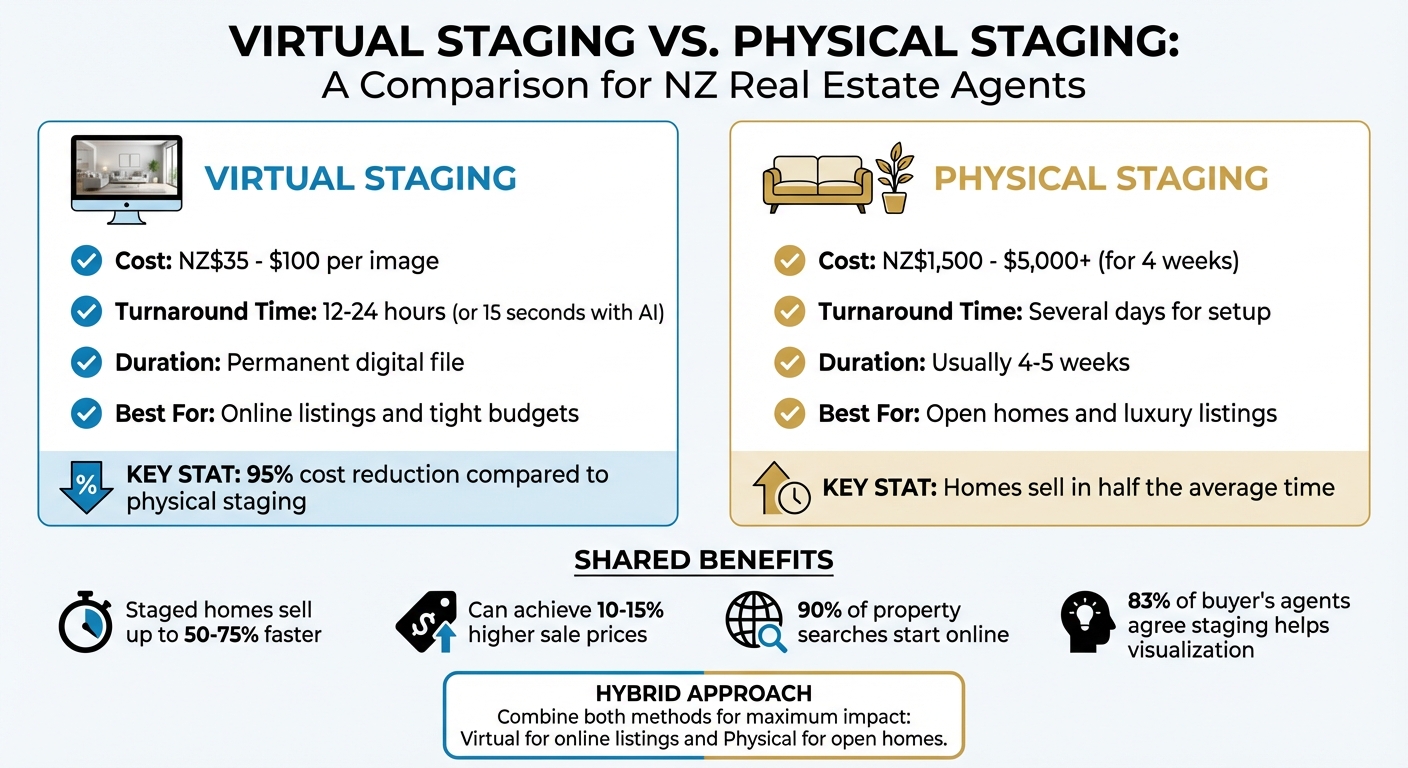
Virtual vs Physical Staging Costs and Benefits in New Zealand Real Estate
Cost and Time Comparison
When it comes to cost, physical staging in New Zealand typically ranges from NZ$1,500 to NZ$2,500 for four weeks, with premium services exceeding NZ$5,000. In contrast, virtual staging is far more affordable, usually costing less than NZ$100 per image. For example, Fast Virtual Staging offers services at just NZ$35 per image.
The difference in turnaround time is just as striking. Physical staging can take several days to arrange, including consultation, delivery, and setup. On the other hand, virtual staging is much faster, delivering results within 12–24 hours. In cases where AI-powered tools are used, the process can be completed in as little as 15 seconds. This speed advantage allows real estate agents to list properties quickly, eliminating delays caused by logistical challenges.
Here’s a quick comparison of the key features:
| Feature | Physical Staging | Virtual Staging |
|---|---|---|
| Cost (NZD) | NZ$1,500 – $5,000+ | NZ$35 – $100 per image |
| Turnaround Time | Several days for setup | 12–24 hours (or 15 seconds with AI) |
| Duration | Usually 4–5 weeks | Permanent digital file |
| Best For | Open homes and luxury listings | Online listings and tight budgets |
"While traditional staging runs into the thousands, virtual only costs a fraction of the price, and can even cost less than $100 per image." – Lyall Russell, LJ Hooker
The affordability and efficiency of virtual staging make it an attractive option for many agents, especially when time is of the essence.
When to Use Virtual or Physical Staging
Choosing between virtual and physical staging largely depends on the property type and marketing strategy.
Virtual staging shines in online-focused campaigns, which is crucial given that over 90% of property searches in New Zealand begin online. It’s perfect for empty homes on a budget, properties needing a quick turnaround, and listings where showcasing versatility is key. For example, you can use virtual staging to present a spare room as both a nursery and a home office, creating multiple appealing scenarios for potential buyers. This approach helps produce visually striking online images that grab attention.
Physical staging, on the other hand, is better suited for high-end properties and open homes, where buyers can experience the layout and flow of a space firsthand. Staged homes in New Zealand have been shown to sell in half the average time and can add 10% to 15% to the final sale price. For a property valued at $1 million, this could mean an additional NZ$150,000.
Many real estate agents now use a hybrid approach, combining the strengths of both methods. Virtual staging is used to generate online interest, while physical staging is reserved for open homes in key spaces like the living room, kitchen, master bedroom, and outdoor areas. This strategy maximises both digital engagement and the in-person viewing experience.
Conclusion
Virtual staging has become a game-changer for real estate agents navigating New Zealand’s digital property market. It provides an efficient way to present homes beautifully, without the hefty price tag or logistical challenges of traditional staging.
With turnaround times as fast as 12 to 24 hours, virtual staging allows agents to list properties quickly and professionally. The cost savings are undeniable, and the benefits go beyond just saving money – staged properties tend to sell more quickly and often fetch higher sale prices. This makes virtual staging not just a convenience but a smart investment.
Fast Virtual Staging offers agents in New Zealand a simple yet effective solution: high-quality, realistic renders, a 24-hour delivery promise, and dedicated customer support to ensure every image is polished and professional. Whether it’s an empty apartment in Auckland, a classic home in Wellington, or a countryside property in Christchurch, virtual staging provides the flexibility to showcase various design styles and attract a wide range of buyers.
FAQs
How do the costs and timeframes of virtual staging compare to physical staging in New Zealand?
Virtual staging offers a quicker and more budget-friendly alternative for real estate agents in New Zealand when compared to traditional staging methods. For just $35 NZD per image, you can have a professionally staged photo, avoiding the hefty costs associated with physical staging. These often include furniture rental, hiring movers, and sometimes even extra expenses like painting or minor renovations, which can pile up fast.
Time is another area where virtual staging shines. Images are typically ready within hours, bypassing the lengthy process of organising furniture delivery, arranging it, and later removing it – a process that can take days or even weeks. For Kiwi agents aiming to cut costs and save time, virtual staging is a practical and efficient choice.
What are the key advantages of virtual staging for real estate agents in New Zealand?
Virtual staging provides real estate agents in New Zealand with a cost-effective, efficient, and visually appealing way to elevate property listings. By digitally adding lifelike furniture and décor to empty or sparsely furnished spaces, agents can transform properties into inviting homes that help potential buyers picture themselves living there. This approach often leads to quicker sales, with staged properties selling up to 75% faster and frequently meeting or exceeding the asking price.
What makes virtual staging even more appealing is its versatility. Agents can easily adjust room layouts, styles, or colour schemes to match the preferences of various buyers – all without the hassle of moving actual furniture. With a typical turnaround time of just one day, it’s a fast and effective solution that helps properties stand out in New Zealand’s competitive real estate market. This blend of speed, customisation, and affordability makes virtual staging a powerful tool for increasing buyer interest and achieving stronger sales results.
Does virtual staging help New Zealand real estate agents sell properties faster and for a better price?
Virtual staging has shown incredible results in New Zealand’s property market, helping homes sell 73–75% faster and often bringing in 5–10% higher sale prices compared to listings without staging. By showcasing a property at its full potential, virtual staging grabs buyers’ attention and helps them imagine living in the space, creating a stronger emotional connection.
In New Zealand’s competitive real estate scene, where standing out is key, virtual staging offers an affordable and efficient way to elevate a listing with high-quality visuals that can attract better offers.